Showcasing humankind's cradle
Lucille Davie
22 March 2005
The new Sterkfontein Cave visitors' centre - the first phase of a multi-million rand development at the Cradle of Humankind outside Johannesburg - is now complete, offering a richer experience at one of the world's most important archaeological sites.
Previously, visitors to the World Heritage Site - situated some 50 kilometres north-west of Johannesburg - bought a ticket at the nearby café, did a brief whip-around of a shabby single-room display, took a tour of the cave, then went home.
Now, a guided tour of the cave - which descends 60 metres underground - is just part of the experience.
You can also visit the new Sterkfontein Cave restaurant (open for lunch and dinner), souvenir shop, auditorium, and hominid exhibition hall with interactive exhibits - this will open in August.
You can also view some of the ongoing excavations from a wooden walkway, and
take a look-in at the laboratory where scientists examine their fossil
finds.
Sterkfontein Cave is the most famous of 13 excavated fossil sites in the broader 47 000-hectare Cradle of Humankind site. Three million years of human activity have taken place in and around the Cradle, including man's earliest-known mastery of fire.
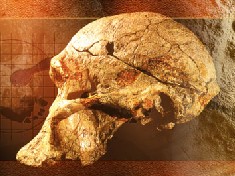
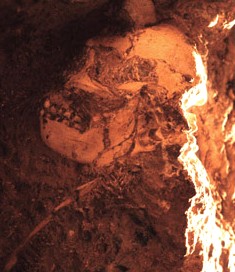
Forty percent of all human ancestor fossil finds have been made here, including several of the world's most famous and important fossils - among them Mrs Ples (now believed to be Master Ples), dating back 2.5-million years, and Little Foot, an almost complete ape-man skeleton between 3 and 3.5-million years old (though a recent study puts it at just over 4-million years old).
A further 500 hominid fossils and over 9 000 stone tools have been excavated in the area, and excavations will probably continue for another 100 years.
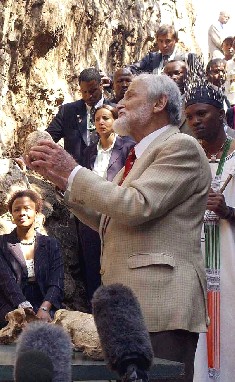
"This is the longest palaentological dig in the world, and we plan to make Sterkfontein an iconic venue", says Rob King, chief executive of the Furneaux Stewart GAPP (FSG) consortium
responsible for the R163-million development.
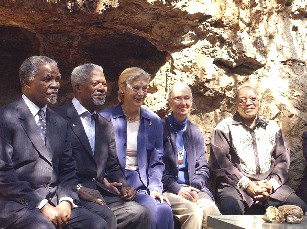
Listening to Professor Philip Tobias (right) during a visit the Sterkfontein Caves during the 2002 World Summit on Sustainable Development (from left to right): South African President Thabo Mbeki, UN Secretary-General Kofi Annan, Mrs Annan, primatologist Jane Goodall, and Deputy President Jacob Zuma. (Photo: United Nations)
Mohale's Gate
Still under construction is the showpiece of the project: the Mohale's Gate interpretation centre, eight kilometres north of Sterkfontein, that will offer an educational journey of discovery taking visitors back four billion years.
It is positioned up the side of the koppie, where ancient rocky outcrops will mark the setting of a huge man-made burial mound or "tumulus". This will be a partly disguised grassy mound 20
metres in height and 35 metres in diameter, to be built in a teardrop shape of steel, glass and concrete.
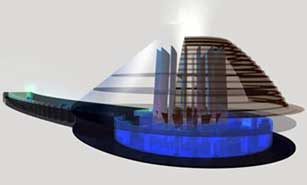 Artist's impression of the Mohale's Gate "tumulus". (Graphic: Cradle of Humankind)
The tumulus will comprise four storeys, with the basement level consisting of an underground lake, which visitors will be able to explore by means of explorers' boats on a delineated path, moving through a time line.
From the lake, visitors will enter a tubular cave that curves around the teardrop structure, taking a 150 metre walk through another time line as they move out of the tumulus.
Along the way, visitors will be able to admire the original Mrs Ples skull and other original hominid fossils.
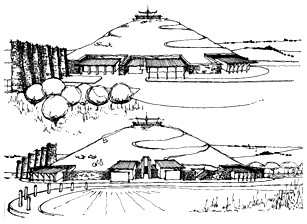 Sketch showing different elevations of the Mohale's Gate "tumulus". (Graphic: Cradle of Humankind)
The rest of the building will consist of a conference centre, offices, a restaurant and an observation deck offering views of the surrounding site.
West of the tumulus will be a five-star hotel in the form of explorers' tents, consisting of 24 units; south-east of the tumulus, an amphitheatre for up to 5 000 people.
When Mohale's Gate opens at the end of 2005, visitors to the Cradle will start there, spending up to three hours in self-guided explorations before moving on to Sterkfontein Cave.
The project involves the FSG consortium, the University of the Witwatersrand and the Gauteng Department of Agriculture, Conservation, Environment and Land Affairs, which is funding the development.
Roads leading to
Sterkfontein are being improved, to the tune of R87-million, according to Gauteng Finance and Economic Affairs MEC Paul Mashatile, who says the province is keenly aware of the potential of the development to increase tourism and create jobs in the area.
"This will become a major attraction for both local and international visitors", he says, at the same time acknowledging the historical importance of the site. "The Cradle of Humankind must be a place where human development is celebrated."
Source: City of Johannesburg


|