|
We the People: Constitution Hill
23 December 2004
South Africa opened its new Constitutional Court building in Johannesburg on the site of a 100-year-old former prison complex where the leaders of every major South African liberation group - Nelson Mandela and Mohandas Gandhi among them - were once detained.
Constitution Hill does more than tell SA's remarkable story - it takes it forward, and invites the visitor to help it in doing so.
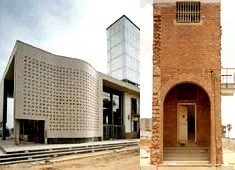
The R492-million Constitution Hill development, built on the 100-acre site of the city's notorious Old Fort prison complex, is South Africa's most ambitious public building project since the country's first democratic elections in 1994.
The opening of Constitution Hill's centrepiece, the new Constitutional Court, on Human Rights Day, 21 March 2004, was both a tribute to the country's maturing democracy and a celebration of how far Johannesburg's regeneration process has come.
Constitution Hill is part of a multi-million rand inner city renewal
process being driven by Gauteng province's development agency, Blue IQ, and the City of Johannesburg. Constitution Hill forms one point of a "cultural arc" that sweeps through Braamfontein - taking in the Civic Centre and Wits University - and across the Nelson Mandela Bridge to Newtown.
Although there is much work to be done to complete the Constitution Hill precinct - which will comprise museums, exhibition spaces, restaurants, offices and a hotel - the site is now open to visitors, who can walk up the Great African Steps, enter Constitution Square, attend a hearing or view the art gallery at the Constitutional Court, climb the Old Fort Ramparts for panoramic views of Johannesburg, or take part in a number of tours and exhibitions (see below).
Visitors can also take part in building the "We, The People Wall", which will take 10 years to complete and will document people's experiences of South Africa's transition.
On completion, Constitution Hill will be a
mixed-use heritage precinct offering a unique cultural, historical, educational, business and recreational space. It will be a place where visitors can experience the story of South Africa's transition to democracy, observe the process by which freedom is now protected, and learn how South Africa is building its future on its past.
'The Robben Island of Johannesburg'
The Old Fort prison complex is the place where more representatives of South Africa's diverse communities were jailed for fighting for freedom than anywhere else in the country.
Nowhere can the story of South Africa's turbulent past and its extraordinary transition to democracy be told as it is at Constitution Hill. To chart the history of the Old Fort - commonly known as Number Four - is to map the history of resistance in South Africa.
For decades, thousands of prisoners streamed through the Old Fort's "delousing" chambers, were made to do the humiliating Tauza dance,
were beaten and abused in the notorious Number Four prison for black men, were held for months in dirty, overcrowded conditions in the Awaiting Trial Block, were stripped of their underclothes and their dignity in the Women's Jail.
The Old Fort prison complex saw it all: from rebellious British soldiers who fought with the Boers at the turn of the century to striking mineworkers, Defiance Campaigners, Treason Trialists, and youths caught up in the Soweto Uprisings.
Both the famous and the infamous were incarcerated at the Old Fort: war rebels, political activists, notorious gangsters and criminals. Activists were usually held as awaiting trial prisoners and then sent off to Robben Island or Pretoria to serve jail terms.
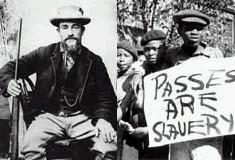
Most of those imprisoned at the complex, however, were ordinary people arrested in their droves every day under the apartheid government's Pass Laws restricting the movement of black people.
Brewing beer – an illegal activity if you were
black – also landed many women in jail. Still others were arrested for having sex across the colour bar or for homosexual sex. And people lived in dread of Number Four, the prison assigned to black men, with its chilling Ekhulukhuthu (the deep hole) isolation cells.
We the People: exhibitions & tours
Constitution Hill's public participation programme, We the People, has begun the long process of inviting ex-prisoners and warders back on to site to participate in research-based workshops.
The images, sounds and voices recorded in these workshops have recreated the tenor of prison life, revealing individual stories and experiences that form the basis of Constitution Hill's exhibitions and tours. Objects, photographs and memories give a sense of how power and punishment were inflicted on the minds
and bodies of prisoners, and demonstrate the efforts that men and women made to overcome prison conditions.
City of Joburg website features:
SA's history tied to the story of a fort
Recollecting the past brings the Old Fort alive
On tour with Albie Sachs
Constitution Hill tour captures essence of SA
Artwork of the Constitutional Court
Constitution Hill's exhibitions are designed as participatory experiences, with facilities for visitors to record their own memories and response to the exhibitions - so setting down another layer of history for future generations to
discover.
Exhibitions and tours currently available include:
- Number Four - The journey to Number Four, the dark heart of Constitution Hill, aims to deepen the visitor's understanding of what it means to be placed at the bottom of the racial hierarchy and how the apartheid system made criminals of black men.
- The Mandela Cell - View a film documenting Mandela's time at the Old Fort, and his emotional return to Constitution Hill some 40 years later.
- The Women's Jail – The grace of this handsome Victorian-style building belies the pain and suffering that occurred within. Currently closed for renovation, the hoarding which protects the building has been transformed into a temporary exhibition honouring the contribution of women to the struggle for freedom in South Africa.
- We the People Wall - Running the length of Constitution Square, at the base of the Old Fort ramparts, contributors range from Nelson Mandela and
other ex-prisoners to ordinary people from across South Africa. Leave your message for the We the People wall.
- We the People: in the Shade of the Constitution – This photographic exhibition is the result of a road-trip across South Africa's nine provinces in 2003, from urban areas to isolated rural communities.
- Objects from the Past – A collection of prison objects and emblems that sheds light on the system of punishment and incarceration in apartheid South Africa.
- Guided tours - A tour of the old prison buildings and the Constitutional Court is a journey through South Africa's painful past, but also a celebration of its remarkable transition to democracy.
For full visitor information, visit Constitution Hill.
Source: Constitution Hill
| |
 |
|
|
|
|
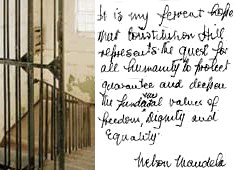
Nelson Mandela laid one of the first "bricks" in Constitution Hill's We the People wall, a growing record of the impressions of ex-prisoners, ordinary South Africans and visitors to Constitution Hill (Photos: Constitution Hill) |
|
"We, the people of South Africa … adopt this constitution as the supreme law of the land …"
Preamble to the Constitution of the Republic of South Africa, 1996
Tell your story
Constitution Hill invites members of the public to share their memories or experiences. If you know someone who was held at the Old Fort prison complex, were one of the hundreds of thousands of people who passed through its gates, or simply walked past its gates and would like to share your thoughts with others, contact Constitutional Hill - and contribute to the future of democracy in SA.
To write to Constitution Hill, visit the website, click on "We the People",
and click on "Tell us your story".
The Dignity Book
Constitution Hill aims inscribe the names of ex-prisoners onto the walls of the buildings that once imprisoned them. In the interim, a Dignity Book will be displayed in Number Four alongside one of the chief warder's old prison registers.
All ex-prisoners are invited to inscribe their names, and the dates of their imprisonment, into the Dignity Book. Those wishing to commemorate dear ones who were imprisoned at the Old Fort prison complex are encouraged to do so.
To write to Constitution Hill, visit the website, click on "We the People", and click on "Dignity Book".
|
|
|