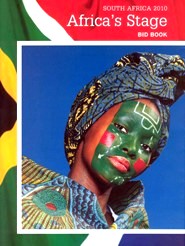
SA's 2010 World Cup bid
28 October 2003
Rugby World Cup 1995, African Cup of Nations 1996, Cricket World Cup 2003 - add golf's President's Cup 2003 ... now South Africa is bidding to bring the Football World Cup to Africa for the first time.
Sports Minister Ngconde Balfour is confident that the country has what it takes to win the right to host the 2010 Football World Cup - but says South Africa is not underestimating the bids of the other four African candidates: Tunisia, Egypt, Libya and Morocco.
"We will bid against them with the same intensity and drive as we would if we were up against any other country", Balfour told journalists at the launch of SA's bid in May. "The government at all levels is right behind the bid, and we have shown already what we can do with the Cricket World Cup."
The Federation of International Football Associations (Fifa), football's world governing body, decided last September that the 2010 event would be held in an African country for the first
time since the inception of the finals in 1958. Fifa has also said it would consider joint bids by more than one country.
The announcement of the winning city is expected to be made in May 2004, after inspection visits and assessments of the bidding countries.
This is South Africa's second bid to host football's world showpiece. South Africa lost its bid to host the 2006 finals by 12 votes to 11 to Germany, after New Zealand's Charles Dempsey abstained from voting as part of Fifa's executive.
South Africa's bid is spearheaded by Danny Jordaan, chief executive of the SA 2010 Bid Company, and Irvin Khoza, the chairman. The company has an R80-million budget with which to get buy-in from all South Africans and, more importantly, from Fifa's 24 executive committee members.
The country's bid has already attracted major corporate sponsors. Mining giant Anglo American and banking group FNB have each pledged R15-million to the bid company; transport utility Transnet
has pledged R12-million; car manufacturer BMW is also on board; while leading life insurer Momentum Group, electronics firm Phillips SA, hotel group Southern Sun and IT firm Choice Technologies have each pledged R5-million as official supplier sponsors.
South Africa's Jomo Sono and Ghana's Abedi Pele have been named as the bid's official ambassadors.
The Contenders
South Africa
After being deprived of the 2006 finals by Charles Dempsey’s abstention, South Africa have reason to be confident, but no reason to be over-confident. The nine votes held by Europe hold the key. The successful hosting of the 2003 Cricket World Cup, the 1995 Rugby World Cup and the 1996 African Cup of Nations could count in the country's favour. Although South Africa is short on world-class soccer stadiums, the country boasts the best rugby grounds, which the soccer authorities are using successfully.
Morocco
Morocco is a resilient
kingdom. Despite three failed attempts (1990, 1994, 2006), the country is at it again, and world football "insiders" believe the fight will ultimately be between Morocco and South Africa. But it will need to start building, as only Casablanca and Rabat have suitable venues.
Tunisia
It's hard to imagine that such a big event could be held in such a small country, sandwiched between Algeria and Libya. Tunisia boasts six international-standard grounds, good infrastructure and a proven record at hosting trouble-free soccer tournaments.
Egypt
Boasts the Cairo Stadium - the biggest in Africa, with a 100 000-plus capacity - but no other venue comes close to World Cup standards. Egyptians have a passion for the game, with matches featuring Cairo club giants Al-Ahly and Zamalek always sell-out affairs. The dark horse in the race.
Libya
The country’s bid is led by Al-Saadi Gaddafi, Libyan leader Muammar Gaddafi's son. Tripoli and
Benghazi have excellent stadiums, and they did a good job as hosts of the 1980 African Cup of Nations. An outsider's chance.
SouthAfrica.info reporter
|