SPORTING GREATS
Soccer: Lucas Radebe
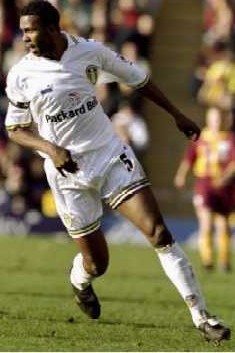
Lucas Radebe rose to prominence when he became leader of Leeds United in the English Premiership, taking charge of a team filled with promising youngsters and some veterans to provide the side with a good blend of youth and experience. Under his leadership the Yorkshire club became the force in English soccer that they had once been.
Radebe’s contribution was two-fold: leadership and performance. He was recognised as one of the finest defenders in the Premier League, if not in the world, and he earned universal respect.
That status was light years removed from his tough upbringing. The fact that he made it as one of its most respected players in the English game - and as South Africa's most-capped footballer, with 69 caps after the 2002 World Cup - is in many ways a miracle.
Radebe was brought up in Diepkloof Zone Four, a tough area of Soweto, as one of 11 children, five brothers and six sisters. Growing up he was witness to many violent incidents and even saw
people shot to death. It was an unsettling environment.
At the age of 15 he was sent to Bophuthatswana, one of the homelands of the apartheid government in an effort by his parents to keep him away from the troubled township. He played soccer to keep himself busy. At that time he was a goalkeeper!
Radebe then made the move from the last line of defence to midfield. Kaizer Chiefs scouts, who signed him up, spotted his talent. Some time later when the chance of a move to England came about, he grabbed the opportunity with both hands. An incident that happened three years previously in 1991 had made him decide to leave the country.
He was on his way to do some shopping for his mother, accompanied by his brothers and one of his sisters and her baby. While walking along the street, they heard gunfire but didn’t pay much attention because, says Radebe: “in Soweto you heard shots all the time”.
He and the members of his family were looking around to see if anyone
had been shot when suddenly he felt a pain in his back. Then he noticed blood everywhere and his left leg went limp. His first thought was that he would never play soccer again.
Radebe was taken to hospital and amazingly nothing vital had been damaged; the bullet had entered his back and exited halfway down his thigh. To this day he does not know who shot him, but suspects that someone had been hired to shoot him rather than allow him to move clubs.
In September 1994 he and Philemon “Chippa” Masinga moved to Leeds United. Radebe, sold by Chiefs for ₤250 000, was really only part of the deal to keep Masinga happy, but as it turned out he became the more valuable investment.
The Leeds’ coach Howard Wilkinson recognised Radebe’s excellent physical attributes and quickly moved him from midfield to centre half. It proved to be an inspired decision. Radebe struggled early on in his English career with injuries and also because he did not see eye-to-eye with the
manager. When Wilkinson was fired George Graham took over the reins and gave the South African star a chance to blossom. It was an opportunity he had been waiting for.
“The Chief”, as Leeds’ fans dubbed him, quickly established himself as a player to be reckoned with. He showed an excellent understanding of the game, strong tackling, fine man-to-man marking and a calming influence on his team mates. Graham recognised both his leadership and ability when he appointed Radebe captain for the 1998/99 season. “It shows the confidence I have in him and how much I rate him,” said Graham, a man not normally given to praise.
When Graham left Elland Road in October 1998 David O’Leary replaced him. The new manager’s first request to the club’s board was to secure the services of Radebe for the rest of his career. O’Leary had served as Graham’s assistant and he understood just how much the South African captain brought to the Yorkshire club. “Lucas should be set in stone and never
allowed to leave,” he said. The Chief signed a four-year contract.
In 1998 Radebe also had the honour of leading South Africa in the country’s first ever appearance in the World Cup finals.
As captain of Leeds, Radebe proved himself a major success. In 1998/99 Leeds finished fourth in the Premiership, thus qualifying for the Uefa Cup. The following season they finished third in England and qualified for the higher profile and more lucrative Champions League. Surprising many, the Yorkshire club made it through to the semi-finals.
Sadly, the cornerstone of Leeds’ defence picked up a knee injury in 2000, and subsequent knee and ankle injuries kept him sidelined for the better part of two years.
However, Radebe fought his way back into the game, and after four matches for Leeds United's reserves, led his country once more at the 2002 World Cup. Radebe was outstanding in Korea and Japan, his timely interceptions, tackles and intelligent reading of the game
frustrating the opposition attack time and again.
South Africa’s national football team may not have progressed beyond the first round, but five goals, one win, one draw and a 3-2 thriller against one of the tournament favourites confirmed South Africa’s arrival as a force in world football.
Ten years and 69 caps since he first took to the field for Bafana Bafana in July 1992, Radebe scored a stunning goal, heading in off the back post from a corner to bring South Africa level with Spain. South Africa lost the match, but finally won the respect of the world - Radebe's mission was complete.
However, Radebe's contribution on the field of play has extended way beyond the conventional boundaries for South African and African footballers. Radebe’s success made players from Africa more marketable, and now every Premiership scout is searching for the next Lucas Radebe.
He has also acted as an ambassador of Fifa for SOS Children’s Villages, and played a big role in
fighting racism in soccer. Such was his input that he was honoured with the Fifa Fair Play Award in December 2000 for his efforts to rid the sport of racism, as well as for his work with young children in South Africa.
"Lucas is not only a fantastic and fair player on the field, but also has a great personality off the pitch, with a big heart for the children of the world," said Fifa chairman Antonio Matarrese.
Said Radebe: “Football has played an important part in uniting races in South Africa, and that is one of the best things I have done.”
Brad Morgan
|