



MediaClubSouthAfrica

Helping the media cover the South African story.
Weather forecasts

Snap daily forecasts for 20 cities and
towns.

|
Geography and climate
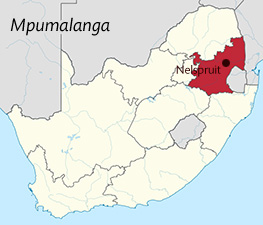
Mpumalanga province, South Africa
Mpumalanga: quick facts
- Capital: Mbombela
- Languages: 27.7% siSwati, 24.1% isiZulu, 10.4% Xistonga, 10.1% isiNdebele
- Population: 4 039 939 (2011)
- Share of South Africa's population: 7.8%
- Area: 76 495 square kilometres
- Share of South Africa's total land area: 6.3%
The land and its people
With a total area of 76 495 square kilometres, Mpumalanga is slightly larger than the Czech Republic. It's second-smallest province after Gauteng, taking up 6.3% of South Africa's land area and with a population of just over 4-million people. About a third of the people speak siSwati, the language of neighbouring Swaziland, with isiZulu, Xistonga and isiNdebele commonly heard. Mpumalanga falls mainly within the grassland biome. The escarpment and the Lowveld form a transitional zone between this grassland area and the savanna biome. Long sweeps of undulating grasslands change abruptly into thickly forested ravines and thundering waterfalls of the escarpment, only to change again into the subtropical wildlife splendour of the Lowveld. The province is a summer-rainfall area, with occasional winter snow on high ground in the escarpment. The escarpment area sometimes experiences snow on high ground. Thick mist is common during the hot and humid summers. Sabie and Graskop provide a large part of the country's total requirement for forestry products. These forestry plantations are an ideal backdrop for ecotourism opportunities, with a variety of popular hiking trails, a myriad waterfalls, patches of indigenous forest and many nature reserves. Lake Chrissie is the largest natural freshwater lake in South Africa and is famous for its variety of aquatic birds, particularly flamingos.Industry
Mpumalanga is rich in coal reserves, and home to South Africa's major coal-fired power stations – three of which are the biggest in the southern hemisphere. EMalahleni, the biggest coal producer in Africa, is the site of the country's two oil-from-coal plants. Mpumalanga produces about 80% of the country's coal and remains the largest production region for forestry and agriculture. One of the country's largest paper mills is situated at Ngodwana, close to its timber source. Middelburg produces steel and vanadium. The best-performing sectors in the province include mining, manufacturing and services. Tourism and agriprocessing are potential growth sectors.Agriculture
An abundance of citrus and many other subtropical fruit – mangoes, avocados, litchis, bananas, pawpaws, granadillas and guavas – as well as nuts and a variety of vegetables are produced in Mpumalanga. Mbombela is the second-largest citrus-producing area in South Africa and is responsible for one third of the country's export in oranges. Groblersdal is an important irrigation area, yielding crops such as citrus, cotton, tobacco, wheat and vegetables. Carolina-Bethal-Ermelo is mainly a sheep-farming area, but potatoes, sunflowers, maize and peanuts are also produced in the region. SouthAfrica.info reporter, incorporating material from the South African Yearbook Updated: October 2015
Would you like to use this article in your publication or on your website? See: Using SouthAfrica.info material
The spectacular Blyde River Canyon and dam in Mpumalanga. (Image: South African Tourism)
Related links
Related articles
South Africa's provinces
Did you know?
FIRST SIGNS OF LIFE
Mountains in the Barberton area of Mpumalanga have yielded minute fossils thought to be among the first signs of life on earth, dated to about 3.3-billion years ago.
Mountains in the Barberton area of Mpumalanga have yielded minute fossils thought to be among the first signs of life on earth, dated to about 3.3-billion years ago.
Photo galleries

South Africa's wildlife
The famous Big Five - elephant, lion, rhino, leopard and buffalo - and more.
National parks
Kgalagadi's desert, Kruger's wildlife, Mapungubwe's ancient heritage, and more.
South Africa's birdlife
Some of the more striking of the 850 or so bird species recorded in South Africa.MediaClubSouthAfrica
Helping the media cover the South African story.
Weather forecasts
Snap daily forecasts for 20 cities and
towns.
|
|