No windfall tax on fuel industry
Lavinia Mahlangu
The South African government has decided against imposing windfall taxes on the country's synthetic fuel producers, citing amongst others, preserving a favourable investment climate in the sector.
The National Treasury said this Monday that the government had decided against the windfall tax in the interest of a "conducive environment for additional investments in domestic fuel security".
In addition, government will not implement a progressive tax regime for upstream oil and gas companies, given the recent enactment of the Tenth Schedule to the Income Tax Act.
These decisions follow recommendations from a report by a task team appointed by Finance Minister Trevor Manuel in May 2006 to investigate the matter, amid concerns that the present policies benefited the synthetic fuel producers and their shareholders disproportionately, at the expense of the consumer and the taxpayer.
This was because local synthetic fuel producers sold their fuels at prices determined by international oil prices with no reference to their lower, and in some cases subsidised local production costs.
The team submitted their report to Minister Manuel in February this year, after which it was published for further public comment until 31 March 2007.
The task team's report recommended the imposition of a windfall tax on existing synthetic fuel producers, an incentive regime for investments in the production of liquid fuel from indigenous raw material, a possible progressive tax regime for upstream oil and gas producers and tax on the "must have volumes" of liquid fuel Sasol supplies to the inland market amongst others.
Windfall profits
According to the National Treasury, the report defines windfall profits as excess profits, of which conceptually there are two possible types: those of a temporary or cyclical nature, called "quasi rent" or "economic profits", or those that are more structural
or permanent, called "economic rent".
Using this definition, the task team concluded that there is evidence that the synthetic fuel industry generates windfall profits of a cyclical nature, but did not conclude it was of a structural or permanent nature.
Although the government did not agree with the team's recommendation to implement the windfall taxes, it agreed that windfalls have been generated in the domestic synthetic fuel industry, though it cannot be concluded that this is due to a structural or permanent change in the price of oil.
The government also shared the team's view to explore an incentive regime for investments in the production of liquid fuel in new synthetic plants to reduce dependency and promote fuel security, and will consider biofuels and other options.
'A win-win outcome'
Sasol chief executive Pat Davies welcomed the government's decision not to impose windfall taxes, saying that it was a "win-win
outcome" for all parties.
"We are enthusiastic about the role we can play in enhancing South Africa's energy security and have started the first phase of significantly expanding our existing synthetic fuels capacity in Secunda," he said in an issued statement.
"We also confirm that we are proceeding with a pre-feasibility study into a greenfields coal-to-liquids facility in partnership with [the] government."
The pre-feasibility study of the project, known as Project Mafutha, is expected to be completed during 2008.
Reducing dependence on imports
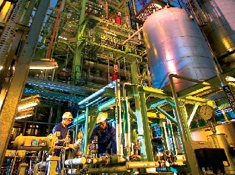
The South African synthetic fuel industry comprises two players - Sasol and PetroSA - both of which have their origins in the government-backed initiatives to reduce dependence on imported oil.
The synthetic fuel industry meets about 30% of South Africa's demand for petroleum products, thereby reducing dependence on imported crude oil for local refining and imported fuel.
Sasol operates commercial scale facilities for conversion of low-grade coal to liquid fuel and is a major contributor to South Africa's petroleum production, while PetroSA converts natural gas to liquid fuel.
Source: BuaNews