





Nelson Mandela
Mandela & Tambo's old offices restored
Restoration
The building, a derelict disaster for the past 10 years, has been restored using old photographs, says Lauren Segal, the curator of the exhibition of Chancellor House. The tall ceilings and interior pillars give the inside a more elegant look than the exterior promises. The ground floor has had its large Fox and Gerard Sekoto street window fronts re-instated. Parquet flooring, gleaming and warm, has been sourced and covers the ground floor and the three offices on the second floor of the Tambo and Mandela rooms, which overlook the Magistrates' Courts across the road. The rest of the office space has grey carpeting, and all walls are crisp white. The other offices have been opened up to create spacious, open-plan areas, with toilets and kitchens running along the north side on each floor. The original entrance on the Fox Street side has been restored, while the courtyard toilets have been demolished, to create a new, enlarged space with plants and benches. A fire escape has been added and a new lift installed. A new roof was constructed, the old one having been damaged by fire and water seepage. Some 68 homeless people had to be removed from the building and were relocated to a shelter, before the City could expropriate the building. Around 30 skips of rubbish had to be removed before a proper assessment could be done, and work could begin.Busy practice
Mandela and Tambo had a busy practice in the building from 1952 to 1960, at times bringing in other attorneys when they were caught up in trials in which they were the accused, like the Treason Trial, for which they were arrested in 1956. In an article titled "Save Chancellor House" in the De Rebus magazine of April 1999, attorney Norman Sher recalls his association with the building. Sher worked in the early 1950s as a clerk while studying to write his matric, in the firm of Berman & Berman, the attorneys who occupied the second floor of Chancellor House. He says: "It seems like yesterday and I can see them firmly imprinted in my mind: Nelson Mandela, a most imposing figure with a charming and genial personality, and Oliver Tambo, in contrast, with his deep penetrating features, a quiet and dignified man who spoke very softly in well-modulated and precise sentences." He described how their offices were "neat and orderly" but crowded with people wanting help with obtaining passes, a process which involved "overcoming almost insurmountable obstacles". Sher acted as a messenger to Tambo and Mandela, and often fell down the narrow staircase while trying to deliver messages as fast as he could. Mandela named him "Haasie", Afrikaans for rabbit, "a nickname which he cherishes to this day with fond memories". He was paid in kind for his messenging duties – he was treated to meals at Kosi's Cafe on the ground floor, "an institution in itself playing host to many famous personalities". Sher says that the three of them became good friends, with him bringing the lawyers their daily lunch of samosas from Kosi's. "Little did I realise then what an important role Mandela and Tambo were to play in the future history of our country."Museum
A museum, to be positioned along the ground floor windows and outside the building, is to be opened at the end of May, says Segal. She explained at the launch, finding it hard to contain her excitement, how she had found documents, including letters, previously unseen photographs, banning orders, police correspondence stamped "Geheim/Secret", invoices, and court admission material, relevant to the Mandela and Tambo practice, at the national archives in Pretoria. "It is a very exciting find; it felt like new stuff," she exclaimed. The material has been deposited with the Nelson Mandela Foundation. The three offices of the law firm will house a library containing a collection of digitised documents of legal cases handled by the two icons. Blown-up photographs with text will fill each of the ground windows, allowing passers-by to participate in the exhibition. "The various exhibitions will be designed to celebrate the history of this area, of the building and of the people who walked through its doors. Many of them, giants of our history, but also ordinary people in search for a better life, basic justice and elementary human rights," said Masondo. Tenants for the building are being sought. They will preferably have a legal connection. Bizos indicated that he was going to approach the legal fraternity to ask them to help maintain the library and a possible legal clinic. "There are enough lawyers who have a social conscience." The shuttered north entrance of the courts in Fox Street will be opened, to allow attorneys to cross the road to use the library and clinic. The Johannesburg Development Agency has overseen the restoration, at a cost of R7-million. "I trust that Chancellor House will remain a beacon of hope for all our people as we continue with our collective efforts to consolidate our freedom and deepen our democracy," concluded Masondo. Source: City of Johannesburg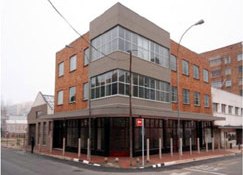
Chancellor House in downtown Johannesburg - where Nelson Mandela and Oliver Tambo practised law in the 1950s - has been fully restored, and will soon house a law library and legal clinic (Photo: Lucille Davie, City of Johannesburg)
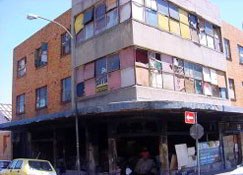
The run-down building before the restoration team moved in (Photo: Lucille Davie, City of Johannesburg)
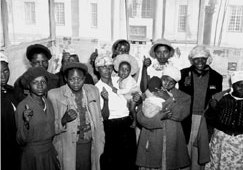
Litigants photographed in the offices of Mandela & Tambo in the 1950s (Photo copyright Jurgen Schadeberg)
Related links
Related articles
Photo galleries

Nelson Mandela
An international hero ... as well as a son, husband, father and grandfather.