South Africa's arts and crafts
South Africa's people produce a remarkable range of arts and crafts, working from the pavements and markets of the big cities to deep rural enclaves, with every possible form of traditional artwork - and then some.
There's a lot of new work in traditional media, with artists constantly developing the African crafts repertoire. These range from pretty tableware, Christmas tree decorations and magnificent embroidered cloths to the simplest of items such as keyrings and candle-holders.
With characteristic inventiveness, South Africans have adapted every possible medium to a market that feeds both locals and tourists.
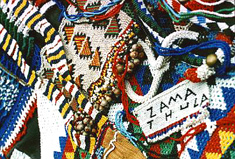
In addition to the standard materials such as beads, grass, leather, fabric and clay, pieces are made using telephone wire, plastic bags, petrol cans and bottle tops - even food tin labels are used to create brightly coloured papier mache bowls.
|

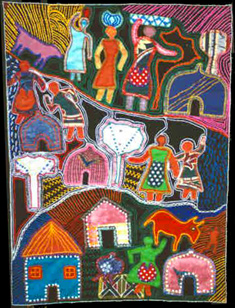
Shops, markets and collectives dealing in African craft are thriving, providing much-needed employment and income in communities such as Fugitive's Drift in KwaZulu-Natal, which offers a huge variety of basketry, or the Northern Cape Schmidtsdrift community of displaced San people who produce paintings that constitute an imaginative and highly coloured extension of ancient rock art.
Folk art, high art
South African folk art is also making inroads into Western-style "high art". The work of ceramicist Bonnie Ntshalintshali, with its almost phantasmagoric detail, has gone well beyond the confines of traditional African pottery - yet her works could still be used at your table.
Sculptor Phutuma Seoka is another artist who has taken a traditional form and given it a personal twist. In his case, the carving of figures using the inherent curves and forks of tree branches, common in the Venda region, is used to creating a cast of eccentric characters.
Some South African artists in the folk art mode have come up with ideas quite out of left field - like the late Chickenman Mkize, who made (now highly valued) mock roadsigns out of cheap materials, emblazoning them with eccentric messages.
The fact that Mkize was illiterate, and was transcribing words written out by others without noting the spaces between the words, adds to the charm of the works. One of them declares "NODRUNK ENBUMS"; another asks, pertinently, "BUTISI TART?"
The Ndebele tradition of house-painting, part of the widespread African practice of painting or decorating the exteriors of homes, burgeoned amazingly with the advent of commercial paints.
It also gave rise to artists such as Esther Mahlangu, who has put her adaptations of the distinctive, highly coloured geometric Ndebele designs on everything from cars to aeroplanes.
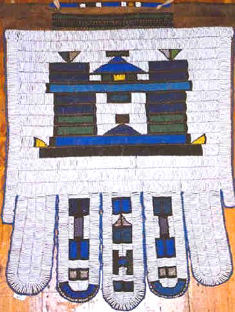
By way of an enlightening contrast, as well as a pure visual feast, there are many Ndebele villages to be visited in Limpopo and Mpumalanga provinces - and the distinctive Ndebele style has been extended beautifully to beadwork.
From traditional to commercial
A high level of
skill is brought to the production of work that has long been a part of African society, and has now found new commercial outlets.
South African beadwork, once the insignia of tribal royalty alone, has today found a huge range of applications, from the creation of coverings for everything from bottles to matchboxes - and the reproduction of the red Aids ribbon in the form of small Zulu beadworks known as Zulu love letters.
Basketry and ceramics, of course, were long ago brought to a pitch of perfection in traditional South African society, and the outgrowths of these forms today grace gallery plinths as often as they find a place on suburban shelves.
There are several important collections of African art in South Africa, such as the Standard Bank collection at the Gertrude Posel Gallery at Wits University in Johannesburg, or the Durban Art Gallery, housing works of historical and anthropological significance.
There can be few other places in the world where you can see this variety of African arts and crafts, whether they be masks made in one of the continent's many styles, or carved chairs, or embroidered or appliqué cloths.
At the Rooftop Market at Johannesburg's Rosebank Mall, and at its African Craft Market, work from all over the continent jostles for buyers' attention. Many merchants and organisations sell craft goods online: check out the brief list of links at right.
SouthAfrica.info reporter, incorporating material from South African Tourism