South Africa's tourism industry
South Africa's scenic beauty, magnificent outdoors, sunny climate, cultural diversity and reputation for delivering value for money have made it one of the world's fastest growing holiday destinations.
The number of foreign tourists visiting South Africa has more than doubled since 1994, from less than three million to a record 6.7-million in 2004.
|

The country is highly diverse in terms of its climate, culture, tourist activities and infrastructure, catering for virtually every tourism niche, from eco- and cultural tourism through to adventure, sport and paleo-tourism.
Adventure tourism
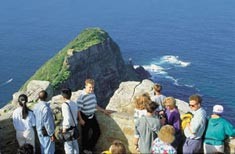
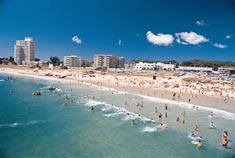
Being at the southern tip of a large continent, South Africa offers 3 000 kilometres of coastline along with breathtaking mountains - often side by side. The country's diverse terrain, together with an ideal climate for outdoor activities, make it an ideal hunting ground for adrenaline seekers.
SA offers world-class climbing, surfing, diving, hiking, horseback safaris, mountain biking, river rafting - and just about any other extreme activity you can name, all supported by dedicated operators.
- More info: South Africa: adventure heaven
With a combination of first-world infrastructure and a resort-like environment, South Africa is an excellent location for international conferences.
The business tourism industry is growing fast on the back of this. According to research published by Grant Thornton in 2005, South Africa hosts around 860 international conference events annually, drawing more than 110 000 foreign MICE (meetings, incentives, conferences and exhibitions) participants.
Overall, the local and international MICE industry is estimated at 101 000 events a year attended by 11 million participants and representing almost 15 million delegate days. The industry contributes around 2.7% to the country's gross domestic product.
Cultural tourism
South Africa is home to diverse cultures, ranging from the Zulus who resisted European conquest to the nomadic San of the Karoo desert. Each
culture has evolved its own distinctive music, art forms and traditional rituals, while the descendants of colonial settlers have evolved variations of their European roots.
South Africa's history has been one of confrontation, but more recently one of reconciliation. Since 1994, a number of world-class sites have been established to commemorate the country's past and celebrate its new unity, while the number and quality of cultural villages, community and township tours has grown dramatically.
- More info: South African cultural experiences
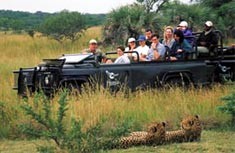
South Africa's diverse climates range from tropical in the south-east to desert in the central region. The scenery runs the gamut from spectacular mountain ranges to vast grass plains, from coastline to meandering rivers to desert dunes. The country's wildlife is far more varied than just the celebrated "Big Five", and is supported by an extraordinary biological diversity.
|
South Africa is leading the way in one of the boldest cross-border initiatives currently unfolding in southern Africa, the development of transfrontier parks. The country's own national parks - including the world-famous Kruger National Park - have grown to 21 in number, and the government is committed to increasing the country's terrestrial protected areas from the current 5.4% to 8%, and its marine protected areas from 11% to 20%, by 2010.
Paleo-tourism
South Africa boasts numerous sites of great archaeological significance. The best known of these are the Sterkfontein, Swartkrans and Kromdraai sites that make up the Cradle of Humankind, one of the world's richest concentrations of hominid fossils.
Others include the uKhahlamba Drakensberg Park, host to the largest and most concentrated series of rock art paintings in Africa, and the Mapungubwe Cultural Landscape, site of an ancient and sophisticated African kingdom that long predated European colonisation. All three of the above are Unesco World Heritage sites.
Sports tourism
World-class venues and supporting
infrastructure, top international events, and South Africans' passion for sport combine to make the country a drawcard for sports fans. More than 10% of foreign tourists come to South Africa to watch or participate in sport events, with spectators accounting for 60% to 80% of these arrivals.
There are numerous world-class sporting events on South Africa's calendar every year, and the country has proved that it can pull off the really big events successfully. SA has already hosted a number of major world cups, including the 1995 Rugby World Cup, the 2003 Cricket World Cup, and the Women's World Cup of Golf in 2005 and 2006.
In January 2006, the only street race in the inaugural A1 GP World Cup of Motorsport series took place in Durban.
Now the country is gearing up for the biggest of them all: the 2010 Football World Cup.
SouthAfrica.info reporter, incorporating material from the Department of Trade and Industry