South Africa's transport network
South Africa has the transport infrastructure of a fully developed country. The roads are world-class. The air and rail network are the largest on the continent. And the country's ports provide a natural stopover for shipping to and from Europe, the Americas, Asia, Australasia and both coasts of Africa.
Seven commercial ports
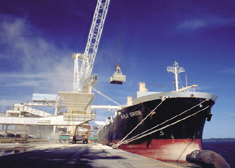
Major shipping lanes pass along the South African coastline in the south Atlantic and Indian oceans. Approximately 98% of South Africa's exports are conveyed by sea, and the country's seven commercial ports form the largest, best equipped and most efficient network on the African continent.
These are: Richards Bay and Durban in KwaZulu-Natal, East London and Port Elizabeth in the Eastern Cape, and Mossel Bay, Cape Town and Saldanha in the Western Cape.
Durban is Africa's busiest port and the largest container facility in southern Africa, while Richard's Bay is the world's largest bulk coal terminal. Taken together, SA's ports handled in the region of 13 000 vessels and 500 million tons of cargo in 2004, and major upgrades are under way to increase handling capacity further.
These ports are not only conduits for trade between South Africa and its partners in the southern African region, but also function as hubs for traffic to and from Europe, Asia, the Americas and the east and west coasts of Africa.
Companies manufacturing for export have the option of locating in one of the country's four industrial development zones (IDZs) - South African adaptations of the export processing zone. South Africa's IDZs are all in close proximity to major ports and airports and offer world-class infrastructure, dedicated customs support and reduced taxation.
Coega and the Port of Ngqura
Coega, comprising an industrial development zone complex and deepwater port 20 kilometres east of Port Elizabeth, is South Africa's largest infrastructure project
since 1994.
The state has already ploughed about R8-billion into the project, including R3.1-billion on the new port, R2-billion on infrastructure in the IDZ, R2.1-billion on the power supply, and R500-million on rail facilities.
Construction on the Port of Ngqura - South Africa's eighth commercial port - is already far advanced. The port, destined to be the deepest container terminal in Africa, will be able to accommodate bigger vessels than any of SA's other ports.
Coega is eyeing at least 14 new investments in the IDZ that could attract R28-billion in the next five years.
In 2005, the Coega IDZ secured its first three tenants, with Belgian-owned Sander International Textiles, German industrial group MAN Ferrostaal and South African company Straits Chemicals announcing investment plans together worth around R2-billion.
Roads and railways
For tourists or freight carriers, the drive from Messina on South Africa's
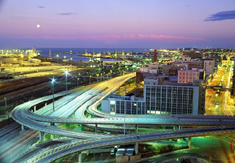
northern border to Cape Town in the south is a 2 000 kilometre journey on modern roads enhanced with sophisticated technology to manage traffic flows and patterns.
The major centres are connected by over 9 000 kilometres of tarred and regularly maintained national highways, including over 2 000 kilometres of dual carriageway, and the numbers are increasing steadily.
South Africa has an extensive rail network - the 10th longest in the world - connecting with networks in the sub-Saharan region.
State company Spoornet is the largest railroad and heavy haulier in southern Africa, boasting some 30 000 kilometres of single rail track, 2 400 locomotives and 88 000 freight wagons.
The company will be investing about R1-billion a year over the next 15 years to upgrade its infrastructure.
Gautrain rapid rail link
Construction on a multi-billion rand high-speed rail link between Johannesburg, Pretoria and Joburg International
Airport will commence in 2006.
Gauteng province's bullet train - the Gautrain - will ease traffic congestion and air pollution on Africa's busiest highways, cruising at 160 kilometres an hour and operating 18 hours a day.
There will be four underground stations, eight surface stations, and some 14 kilometres of underground track, in some places up to 80 metres below the surface.
Airports and airlines
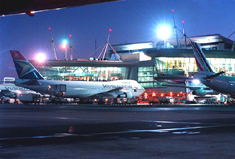
Over 50 airlines and more than 20 million passengers a year move through South Africa's nine principal airports, including the three major international airports in Johannesburg, Cape Town and Durban.
Johannesburg International Airport was named the leading airport in Africa at the 2005 World Travel Awards (Cape Town International came second), while Cape Town International took the 2005 Skytrax Best Airport in Africa award (beating Joburg International into second place).
The busiest airport on the continent, Joburg International's passenger traffic has grown to over 13 million a year. The airport's new domestic terminal, the largest in Africa, opened in 2003, increasing the airport's total capacity to 18 million passengers annually.
Cape Town International's traffic has grown to over 6 million passengers a year. In 2003 the airport opened a new world-class international terminal with a capacity for up to five million passengers a year.
Airports Company South Africa will spend about R5-billion on further airport upgrades around the country ahead of the 2010 Football World Cup to be hosted in South Africa.
South Africa's national carrier, South African Airways, serves over 500 cities and provides maintenance for 47 of the world's airlines.
SouthAfrica.info reporter