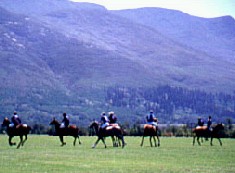
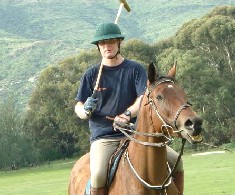
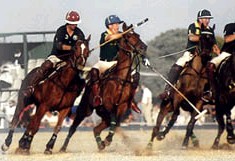
Polo has been played in South Africa for over a century. Due to the number of highly trained horses needed to play the game, it has traditionally been a sport for the well-heeled, and even now there are only about 320 registered club players in the country.
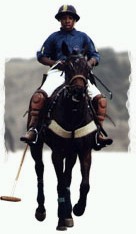 The SA Polo Association runs regular junior coaching clinics, with bursaries on offer for development players
|
And "polo tourism" is beginning to make its mark, with South Africa offering a number of exciting venues - and stunning value-add packages - for lovers of the game who are ready to travel.
(By the way: if you're under the impression that polo originated with British royalty, that it's the exclusive preserve of white westerners, or that it's a gentle Sunday afternoon sport enjoyed by the "gin-and-tonic brigade", think again - see more on the sport and its history below.)
Polo on the Garden Route
If you want a relaxing time in traditional Cape-Dutch accommodation at the coast, you can't go wrong at the exclusive Kurland estate outside Plettenberg Bay, on the Western Cape's renowned Garden Route.
Kurland is a relatively new name on the South African polo map, but it has raised the profile of the game in South Africa - because it has taken it to a new part of the country, and because it has gone "where the money is".
Kurland's polo complex, on a 700 hectare estate, boasts four boarded fields, a 50m by 100m arena, fully equipped stables and veterinary clinic, a one kilometre sand exercise track and paddocks for up to 300 horses.
Individual tuition is available from resident polo professionals; there's also an extensive network of soft roads through forests and pastures for leisure riding.
The Kurland International test match, involving South Africa and other polo-playing countries, takes place every December.
Polo plus safariIf you want to combine a safari with your polo holiday, then it's Karin's Camp Safari in the Waterberg Mountains in Limpopo province that you're after. Karin's offers rhino, giraffe, leopard and all the plains antelope for viewing, while the Big Five are just a 45-minute drive away. Polo in the mountains
If you like mountains, then Franshoek in the Maluti Mountains is your destination. Franshoek is situated in the gorgeous eastern Free State, bordering Lesotho, and there is plenty to keep you entertained - horse riding, trout fishing, abseiling, winter skiing, game drives, cave visits to a sangoma … the list goes on. Still in the Maluti Mountains, Poloafrica offers an exhilirating polo experience on Uitgedacht farm, which boasts two full-sized polo fields, an arena field and a stick and ball field. The setting for the A field is one of the most spectacular in the country, at the head of a valley with a bass-filled dam at one end and mountain views at the other.
Poloafrica is also helping a neighbour, Sandstone Estates, to restore one of South Africa's oldest existing polo fields. This Anglo-Boer War era polo field is expected to be playable in 2007.
Poloafrica offers visitors a "complete polo experience" tailored to suit each individual's requirements and skill levels
Another choice is the Blueberry Park Polo School in the southern Drakensberg's beautiful Underberg, where long-time national star Russell Watson teaches the intricacies of the game. It's even possible to purchase trained polo ponies for all standards of play through Russell. And the Drakensberg is a spectacularly scenic part of South Africa, boasting the country's biggest concentration of private game reserves. Tel: +27 (0)33 702 0902
More resident pros
Oaklands Country Manor, in association with the Harrismith Polo Club, offers a range of reasonably priced polo packages to suit every need and budget, organised by former South African international Francis Mandy. Oaklands is situated on the Drakensberg escarpment in the eastern Free State, roughly halfway between Johannesburg and Durban.
The image that polo conjures in many minds is one of "a gentle Sunday afternoon sport enjoyed by the gin-and-tonic brigade".
In reality, the South African Polo Association argues, polo is one of the toughest and most demanding of sports.
"Polo is rated by insurance companies as the most dangerous contact sport in the world, with ice hockey in second position", the association maintains. "Players have only a helmet for protection and travel at speeds of up to 40kmph on horses weighing up to half a ton. Other players use their ponies to ride each other off the line of the ball and, sadly, accidents are not uncommon.
"The skills required by a top polo player are a combination of the hand-eye co-ordination of a cricketer, the agility of a gymnast, the fitness of a footballer and the strength and courage of a rugby player - and on top of this excellent horseman."
History of polo in South Africa
According to the SA Polo Association, the sport was brought to South Africa by British cavalry regiments garrisoned in the Eastern Cape in the late 19th century, with the country's first recorded polo tournament taking place at King Williamstown in 1885.
The idea that polo started with British royalty, the association points out, is off the mark. Its origins lie "somewhere in Persia or China". The abovementioned British troops learnt the game in India not long before they brought it to South Africa. The word "polo" itself comes from the Gujarati word "pulu", meaning "ball", and there are tapestries depicting the sport dating back to the fourth century AD.
"Far from being the exclusive preserve of white westerners, polo is still very popular in India, Pakistan, Brunei and some more remote regions reaching into Nepal (where it is played on elephants)", the assocation says.
Many African countries, particularly Ghana, Kenya, Nigeria, Zambia and Zimbabwe, play polo, and the association holds annual social tours with many of them. "The curtain-raisers before each Test include players from the association's junior coaching clinic, where a number of development players learn the game."
Established tournaments in South Africa include the BMW International Polo Series played annually at Shongweni in KwaZulu-Natal and Inanda in Johannesburg, and the Kurland International played in Plettenburg Bay in the Western Cape every December.
The SA Polo Association was formed in 1905, and four polo provinces are affiliated to the controlling body - Highveld, East Griqualand, KwaZulu-Natal, and Free State/Cape. The association is affiliated to the Hurlingham Polo Association, the generally recognised world body of polo. There are 33 clubs in South Africa with about 320 players.
SouthAfrica.info reporter