Robben Island remembers
As a symbol of the brutality of South Africa's apartheid past and of the immense
courage of those who fought for the country�s freedom, Robben Island, about 12km
offshore from Cape Town, is a pivotal beacon in the history of South Africa.
The island was declared a World Heritage Site by the United Nations Educational,
Scientific and Cultural Organisation (Unesco) in 1999.
In its description of the site, Unesco writes: "The buildings of Robben Island bear
eloquent testimony to its sombre history, and at the same time symbolise the triumph
of the human spirit, of freedom, and of democracy over oppression."
'Unwanted' people
Although people lived on Robben Island thousands of years before the sea separated it
from the Cape mainland, it was used as a place to house "unwanted" people - mostly
prisoners - from the mid-1600s, when the Dutch colonised the Cape, to the late 20th
century. It was also used as a military base during the
Second World War.
Those who fought against Dutch colonisation in southern and eastern Africa, religious
Muslim leaders, opponents of British empire building in Africa, prisoners of war,
criminals, leprosy sufferers, mentally ill patients, and more recently opponents of the
apartheid government, were all packed off to Robben Island.
As author Lawrence Green wrote: Robben Island was "an island of exiles".
The windswept island, with its astounding legacy of confinement and brutality for
those exiled there - and its paradoxical existence as a sanctuary for bird and animal
life - is a place of mystery and amazement to the many who visit it.
Memories of brutality
For the many freedom fighters imprisoned there, including Nelson Mandela, who was
incarcerated for 27 years, and Pan Africanist Congress leader Robert Sobukwe, who
was housed there in solitary confinement, Robben Island holds less mystery and more
torrid memories of
brutality, isolation and victimisation.
But the island is remembered just as much as the site where anti-apartheid activists
honed their principles of non-racialism and human rights, where they educated
themselves - and their prison warders - and strengthened their resolve to attain
freedom.
As African National Congress (ANC) stalwart and former Robben Island prisoner
Ahmed Kathrada remarked around the time of Mandela's release from prison: "While
we will not forget the brutality of apartheid, we will not want Robben Island to be a
monument to our hardship and suffering. We would want Robben Island to be a
monument � reflecting the triumph of the human spirit against the forces of
evil. A triumph of non-racialism over bigotry and intolerance. A triumph of a new
South Africa over the old."
Kathrada's wish has been realised. On 1 January 1997, Robben Island became the
home to the Robben Island Museum, a national museum and monument that
displays
its astounding history to the many tourists who flock there in search of more
information and understanding about South Africa's past.
- Website: www.robben-island.org.za
-
A place to learn about SA's democracy
The museum is also a place of learning, with workshops, tours and camps for children
and adults keen to learn about both historical and modern-day South Africa and its
embracing of a culture of human rights and respect for ethnic, cultural and religious
diversity.
Daily tours are offered, weather permitting, leaving from the Nelson Mandela
Gateway at the V&A; Waterfront. The tour is three-and-a-half hours long, including the
two half-hour ferry rides. It is a good idea to pre-book your ticket through the
website.
Visitors can expect an enriching experience. There's plenty to see on the island: from
the maximum security prison
that held political prisoners, to the memorabilia of
prisoners incarcerated there, to the quarry mines where prisoners were forced to dig,
to the church, to the many buildings dating back to the Second World War. There's a
small village where the island's main centre is located.
Bird sanctuary
Robben Island generates its own electricity and is involved in a research initiative to
draw electricity from the strong waves that pound its shores. It also gets its water
from nine boreholes.
The island is a natural sanctuary for bird life - the northern part is a bird sanctuary -
and has about 132 bird species, some of which are endangered.
Many birds use the island for breeding purposes, including the Crowned Cormorant
and Black-crowned Night Herons that flock to the island in numbers. The African
Penguin, once close to extinction, also breeds prolifically on the island.
Plant life also thrives on Robben Island, but farming and
the introduction of exotic
species have upset the natural fauna to some extent. The spectacular veld flowers
typical of the West Coast also occur on the Island during spring.
There are 23 species of mammals, including small herds of bontebok, springbok,
steenbok, fallow deer and eland. Ostrich, lizards, geckos, snakes and tortoises also
call the island home.
Marine life around Robben Island is also rich, and the ferry trip offers tourists a
chance to spot Cape fur seals, southern right whales and dusky and heavyside
dolphins.
Reviewed: November 2013
SAinfo reporter





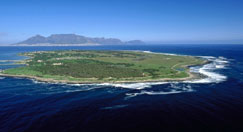 Freedom ... in sight, but a million miles away for Robben Island prisoners (Photo: South African Tourism)
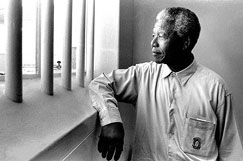 Veteran photographer J�rgen Schadeberg documented Nelson Mandela's return visit to his Robben Island cell in 1994 (Photo strictly copyright J�rgen Schadeberg)
 The quarry on Robben Island (Photo: R�diger W�lk, Wikimedia Commons)
 Film set of the Robben Island prison courtyard, painstakingly created for the movie Long Walk To Freedom (Image copyright Videovision Entertainment)

