


16 Days of Activism against abuse
24 November 2010
Imagine if, for 16 days, there was no rape, no child abuse. The 16 Days of Activism for No Violence Against Women and Children campaign challenges South Africans to declare a truce on violence against women and children – and, ultimately, to make it a permanent one.
Around the country, South Africans are being called on to combat violence against women and children.
 For the 11th year, South Africa is taking part in the global 16 Days of Activism for No Violence Against Women and Children campaign, which runs from 25 November (International Day for the Elimination of Violence against Women) through to International Human Rights Day on 10 December.
While the campaign runs only for 16 days each year, its objectives are reinforced by a year-long 365 Days programme and a national plan to combat abuse.
South Africa is still home to high levels of violence against its women and children, despite a world-renowned Constitution and a legislative overhaul that safeguards women's and children's rights.
The government, business, civil society organisations, faith-based organisations and the media are all participating in the drive to increase awareness of the negative impact of violence and abuse on women and children.
The campaign also aims to:
- Challenge the perpetrators of violence to change their behaviour.
- Involve men in helping to eradicate violence.
- Provide survivors with information on services and organisations that can help lessen the impact of violence on their lives.
What you can do
South Africans are urged to support the campaign by wearing a white ribbon – a symbol of peace – during the 16-day period to symbolise their commitment to never commit or condone violence against women or children.
Other ways of supporting the campaign:
- Speak out against woman and child abuse. Encourage silent female victims to challenge abuse. Report child abuse to the police. Men and boys are encouraged to talk about abuse and actively discourage abusive behaviour.
- Seek help if you are emotionally, physically or sexually abusive to your partner and/or children. Call the Stop Gender Based Violence helpline on 0800 150 150.
- Check out the calendars and take part in a 16 Days event.
- Join a CyberDialogues discussion about issues related to the abuse of women and children. The discussion takes place online in chat-room format, as well as in Thusong Centres around the country. For more information, see Gender Links or visit your local Thusong Service Centre.
- Volunteer some of your time and energy in support of a non-governmental organisation or community group working in your area to help abused women and children.
- Donate some money to organisations working to end violence against women and children by making a contribution to the Foundation for Human Rights. Tel: 011 339 5560/1/2/3/4/5.
- Join a community policing forum (CPF) or community safety forum (CSF) to help fight crime in your area. For information on how to join, contact your local police station.
Rhetoric and reality
South Africa, according to non-governmental organisation Gender Links, needs to close the gap between the "rhetoric of gender equality" and the "reality on the ground".
Gender Links says the country has made impressive strides in recognising the roles and rights of women and children.
The Constitution recognises gender equality as the cornerstone of South Africa's democracy, and new legislation – such as the Choice on Termination of Pregnancy Act and the Domestic Violence Act – have been lauded for enforcing the rights of women.
But more needs to be done. "Changing laws can be swift," says Gender Links. "Giving them effect, and changing the mindsets that often render them ineffective, is a much more demanding task."
Torch of Peace
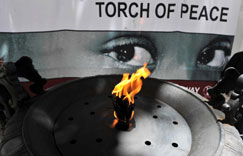
At the media launch of this year's campaign at the Imbizo Centre in Cape Town on Tuesday, Minister for Women, Children and Persons with Disabilities Lulu Xingwana helped to light a Torch of Peace to symbolise the fight to end violence against women and children in the country.
Xingwana said that as part of the campaign, her department would be organising a meeting of children's rights organisations to look into the rights that are afforded to children through various pieces of legislation.
She said the process had become even more urgent following the incident at Jules High School in Johannesburg, where a girl was filmed allegedly having sex with two boys.
The department is also concerned that there may still be people in possession of cellphone video clips recorded during the incident. "That video clip constitutes child pornography, and production and/or possession of child pornography is illegal," Xingwana said.
Forced marriages
The minister said the department had also received increased reports about forced marriages involving children, under the age of 16, which was statutory rape.
She said parents often actively took part in arranging these weddings, as they stood to benefit from the lobola when such a wedding took place, adding that she had worked with the district mayor in Eastern Cape's OR Tambo District, where it was very common.
The department also planned to visit the province on this issue, but Xingwana added that the Office of the Premier in the Eastern Cape was running workshops with traditional and religious leaders to tackle the issue.
The department was also looking at the issue of witchcraft, which she said was a "backward cultural practice" that often saw old women being targeted as witches and killed.
Preventative strategies needed
Also speaking at Tuesday's media launch, Colleen Morna, executive director of Gender Links, said there was a need to develop more preventative rather than reactive strategies for combating abuse against women and children.
She said the country also needed to set up a structure for addressing gender violence which brought together business, civil society and the government, similar to the South African National Aids Council.
Morna said civil society would be involved with various events during the campaign and emphasised that a big focus would be on women speaking out on violence.
Gender Links has also arranged for men who are ex-perpetrators of violence against women to speak out during the campaign.
SAinfo reporter and Buanews
Would you like to use this article in your publication or on your website? See: Using SAinfo material




 Facebook
 Twitter
 Mobile
 RSS feeds
 Newsletter
 Weblines
