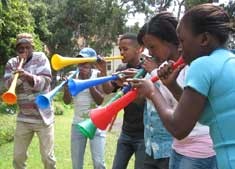
Get set for the vuvuzela orchestra
Lucille Davie
28 November 2006Even if soccer's not your passion, come 2010 there'll be other things to get you jumping up and cheering ... like a vuvuzela orchestra, brainchild of musician Pedro Espi-Sanchis.
"I couldn't stand the idea of the 2010 Soccer World Cup with the world coming here and not hearing a lot of music," says Espi-Sanchis. "South Africa is one of the most musical countries in the world."
Vuvuzelas are one-metre long plastic trumpets, their elephant-like blasts most often heard at local soccer matches. They come in a variety of bright colours, and were first heard in 2001, when they were manufactured by empowerment company Masincedane Sport.
They were not meant to be used as musical instruments. But while they have not made music before, says Espi-Sanchis, "there is no reason why they shouldn't."
When South Africa was awarded the hosting of the World Cup in May 2004, around 20 000 vuvuzelas were sold on the day. There is talk of making it the official instrument of the 2010 tournament.
'Musical representation of ubuntu'
Espi-Sanchis, known on local TV stations as Pedro the music man in Kideo, says he hopes the orchestra will be "a musical representation of ubuntu.
"This means that no one will play louder than others, and no one will play the same rhythm. What people play will interlock with others and complement what others offer."
Espi-Sanchis has taken six vuvuzelas and created six different instruments that each play a different note. They are of varying sizes - he has cut the vuvuzelas to the sizes to vary the normal B-flat tone of the instrument.
He plans to have 36 members in the orchestra, with six groups of six musicians each playing one of six notes. The musicians will dance while playing their instruments, a tradition of African music-making. In 2010 the audiences will hear Shosholoza, the national anthem and other songs that fans have created for their teams.
He is currently holding auditions in Diepsloot, north of Johannesburg, and hopes to form an orchestra with members aged between 14 and 25 years. "We can accommodate any level of skill," says Espi-Sanchis.
The first public performance by the vuvuzela orchestra - which Espi-Sanchis plans to call the Vuvu Carnival Orchestra - will be at the New Year's carnival, a parade through the streets of Johannesburg.
Espi-Sanchis also plans to have a percussion band playing on New Year's eve using pots, pans, discarded car parts and other assorted bits of metal, based on Brazilian carnival bands. He is also preparing for an Africa Day concert on 25 May next year.
And in 2010 ...? Espi-Sanchis has a vision of soccer audiences playing along, based on the colour of their vuvuzelas and notation projected onto large screens in the stadiums.
African pipe ensembles
Espi-Sanchis says the vuvuzela orchestra will use
the same principles used in three pipe ensembles played in southern Africa: the Tshikona of the Venda, the Dinaka of the Bapedi - both from Limpopo province - and the Dithlaka in Botswana.
"The principle was the same: no one is doing something that someone else is doing - there would be one big drum beat, and other beats with other drums," he explains.
There is also a tradition of playing a similar instrument, a tin pipe in a horn shape, in ensembles in central Africa.
Espi-Sanchis, born in Spain, educated in France and an immigrant to South Africa in 1971, joined the Andrew Tracey Steelband Ensemble in 1976, learning to play many traditional African instruments.
In the early 1980s he was curator of the Percival Kirby Collection of African Instruments, and co-founder of the Talking Drum Music Workshop for children. In the late 1980s he gave workshops and courses on African music at universities, colleges of education and NGOs across the country.
From 1994 onwards he has worked as a freelance musician and educator, doing TV shows, touring schools and appearing at festivals here and in Europe. He has presented papers and workshops here and in the US, UK and Amsterdam.
He is currently involved in training arts and culture teachers to think creatively about making music, by using dry seaweed, a paw-paw leaf - or a piece of plastic pipe - as a musical instrument.
Source: City of Johannesburg