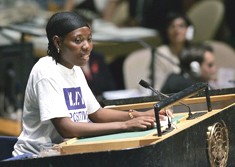
SA woman addresses UN
1 June 2006
Nkhensani Mavasa became the first person who has publicly acknowledged that she is living with HIV to address the United Nations General Assembly on Wednesday.
Speaking on the opening day of the UN's High Level Meeting on Aids in New York, Mavasa urged countries to act rather than make empty promises in the global fight against HIV/Aids.
The deputy chairwoman of South Africa's Treatment Action Campaign, who is representing the International Women's Health Coalition at the UN conference, made a special appeal to the governments of African countries, where women account for 77% of new HIV infections.
"I call on African leaders sitting here to protect and promote the human rights of all people in vulnerable groups - particularly women and girls. We ask that you do not fail us yet again," Mavasa said.
UN Secretary-General Kofi Annan opened the meeting by saying that most countries had failed to meet the targets they pledged to achieve at the UN's special session on Aids in 2001.
World failing women, girls: Annan
"And the world has been unconscionably slow in meeting one of the most vital aspects of the struggle: measures to fight the spread of Aids among women and girls," Annan said, noting that young women around the world suffered double the HIV infection rates of young men.
UN member states pledged in 2001 to adopt national strategies to promote women's rights, protect women and girls from all forms of discrimination, and empower them to protect themselves against HIV.
A dozen heads of state, more than 100 cabinet ministers and some 1 000 civil society and private sector representatives are attending the meeting, which will conclude on Friday, according to the UN, with "a renewed political commitment and agreement on future action to reverse the global Aids epidemic and reduce its impact."
"Your big task now is making sure this ... is not a document of empty promises, not a mere restatement of principle, but a platform for target-based action," Mavasa told the delegates.
"I ask that as you deliberate over the next two days, you'll be guided by the pain and hope which sit in our hearts."
The feminization of Aids
General Assembly president Jan Eliasson, referring to the symbolism of Mavasa's participation, told the meeting that the face of the pandemic had increasingly become young, poor and female - yet only one in five young women knew how to prevent HIV transmission, and fewer than one in 10 HIV-positive pregnant women were receiving antiretroviral treatment.
"I very much hope that the feminization of the epidemic will be a major element of our deliberations this week, and that we will take decisions which will have a tangible impact on young women's lives," Ealiasson said.
Speaking to Health-e News Service ahead of her departure for New York this week, the 27-year-old from Tzaneen in Limpopo province said that when she told her father she was HIV-positive, he ordered her to leave the house and has refused to speak to her ever since.
Challenging patriarchal practices
This hasn't stopped her from challenging the stigma attached to HIV/Aids - or the patriarchal practices in her home community.
"In Limpopo, our villages are dominated by people believing in culture," Mavasa told Health-e. "There are duties for men and duties for women. Men are the head of the household. Women are not allowed to wear pants, talk in meetings or work (in the formal sector.
"They have to cook, bear children, collect firewood and grow crops."
Treatment Action Campaign general secretary said Mavasa's life was "a great story of brevity and exemplary leadership, fighting patriarchy in a community where women still have to kneel when they bring food to men."
SouthAfrica.info reporter
|