|
Colonial expansion
The Xhosa-speaking people living in the region now known as the Eastern Cape encountered the colonists when the latter began moving east. A situation of uneasy trading and more or less continuous warfare began to develop. By this time, the second half of the 18th century, the colonists - mainly of Dutch, German and French Huguenot stock - had begun to lose their sense of identification with Europe. The Afrikaner nation was coming into being.
As a result of developments in Europe the British took the Cape over from the Dutch in 1795. Seven years later the colony was returned to the Dutch government, only to come under British rule again in 1806, recaptured because of the alliance between Holland and Napoleon. The initial somewhat cautious regulations aimed at ameliorating the conditions under which, for instance, Khoi servants were employed, caused discontent and even open rebellion among the colony's white inhabitants. On the other hand, British military strength began to tell
in the conflict with the Xhosa.
In 1820 some 5 000 newly arrived British settlers were placed on the eastern frontier with the intention of forming a defensive buffer against the Xhosa - a strategy that failed when many of them gave up the struggle with uncooperative land and turned to other occupations in Port Elizabeth and Grahamstown. The Xhosa reacted with heroic defiance at the additional pressure on their land and independence - with the eventual tragic result in 1857 of mass starvation as a result of a prophecy that the whites would return to the sea if the Xhosa would slaughter their cattle and destroy their crops.
After 1806, philanthropically-inclined missionaries had begun arriving, their liberalising influence reaching its high point in the activities of John Philip, friend of the British abolitionist William Wilberforce and local superintendent of the London Missionary Society. This development and, in particular, the emancipation of slaves in 1834 had
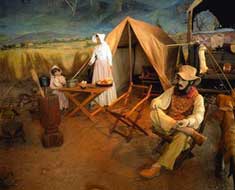
dramatic effects on the colony, precipitating the Great Trek, an emigration north and east of about 12 000 discontented Afrikaner farmers (or Boers). These people were determined to live independently of colonial rule and what they saw as unacceptable racial egalitarianism.
The early decades of the century had seen another event of huge significance: the rise to power of the great Zulu king, Shaka. His wars of conquest and those of Mzilikazi - a general who broke away from Shaka on a northern path of conquest - caused a calamitous disruption of the interior known as the mfecane. Ironically, it was this that denuded much of the area into which Trekkers now moved, enabling them to settle there with a belief that they were occupying vacant territory. But this belief was by no means accompanied by an absence of conflict with the Zulu armies and others.
Initially, many Trekkers moved east into the Natal area (now the province of KwaZulu-Natal) under the leadership of Piet
Retief who, intending to negotiate for land, was murdered with a party of followers and servants at the kraal of Dingane, Shaka's successor. The Battle of Blood River gave the Boers victory in the war that followed. They began to settle in Natal, but smaller conflicts followed and the British - fearing repercussions in the Cape Colony - annexed Natal, where a small British settlement called Port Natal (later Durban) had already been established. On the Highveld, however, two Boer republics were formed: the central Orange Free State and South African Republic (Transvaal or ZAR - Zuid-Afrikaansche Republiek) to its north.
By the mid-1800s the tiny refreshment post at the Cape of Good Hope had grown into an area of white settlement that stretched over virtually all of what is today South Africa. In some areas the indigenous Bantu-speakers maintained their independence, most notably in the northern Natal territories which were still unmistakably the kingdom of the Zulu. Almost all
were eventually to lose the struggle against white overlordship - British or Boer. One territory that was to retain independence was the mountain fastness where king Moshoeshoe had forged the Basotho nation by offering refuge to tribes fleeing the mfecane. Clashing with the Free Staters, he asked Britain to annex Basotholand, which was done in 1868. Known today as Lesotho, this country is entirely surrounded by South Africa but has never been a part of it.
| |
|