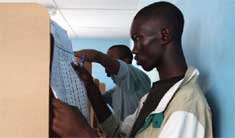
DRC elections 'free and fair'
David Masango
4 August 2006
The elections in the Democratic Republic of Congo (DRC) were conducted in a free and fair manner, South Africa's observer mission has concluded in an interim report.
The mission's leader, Defence Deputy Minister Mluleki George, released the interim report at the South African embassy in Kinshasa on Thursday.
The report focuses on a number of elements crucial to democratic elections, including adherence to an electoral framework; voter registration; political party registration; campaigning; voter education; media freedom; and the operations of the DRC's Independent Electoral Commission.
The interim report covers the period from 19 July to election day on 31 July. The mission will continue with its observation of the counting and processing of election results, after which a detailed final report will be released.
"The mission collected data by attending rallies, meetings called by the competing presidential and parliamentary
candidates, as well other relevant stakeholders," George said. "[It] observed the general atmosphere of the election campaign."
'High degree of professionalism'
George said the DRC's electoral commission had, despiter difficult conditions, logistical challenges and limited resources, displayed a high degree of professionalism, independence and impartiality with the assistance of other institutions in the country and internationally.
He said the electoral framework was adhered to and the voters' roll made available at polling centres for inspection.
"Before election day, many voters went to check their names on the roll ... [V]oters whose names did not appear on the roll were assisted by the [commission]. Those who lost their voting cards were issued with duplicate cards," George said.
Peaceful environment
Close to 270 parties registered for the elections, with 33 presidential candidates and 9
632 candidates for the 500-seat national assembly.
George said campaigning had proceeded in a relatively peaceful environment, with candidates able to conduct campaigns and political rallies well attended and in most cases without incident.
Tolerance
"Overall, there were high levels of political tolerance demonstrated by candidates and the electorate," the deputy minister said. "Even groups that were, for various reasons, opposed to the elections were given the opportunity to demonstrate.
The mission noted that some lives were lost during isolated incidents of violence. "While this was tragic, the election campaigns, in general, proceeded peacefully and voters were not deterred from going to voting stations on election day," George said.
The deputy minister said an effective education campaign was conducted in a multi-faceted fashion, drawing in governmental, non-governmental and political party resources and networks.
"The [mission] noted the important role played by radio in the education programmes. This helped some of the many people who do not have access to televisions and newspapers."
Freedom of expression
George commended the extensive coverage the election process received in the media, saying there was "equitable access to the media and the allocation of airtime during the elections."
SA's observer mission, he said, had concluded that election campaigns were conducted "in a climate free from fear of repression of divergent viewpoints."
Source: BuaNews


|