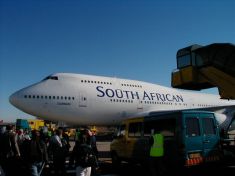
Diverse transport network
South Africa has one of the most modern and extensive transport infrastructures in Africa.
This infrastructure plays a crucial role in the country's economy and is depended on by many neighbouring states.
Public company Transnet (a parastatal) is South Africa's main transport operator and is the main holding company for SAA (airways), Spoornet (rail transport), Autonet (road transport), Petronet (liquid petroleum), Portnet (port authority) and freightdynamics (container shipments). Transnet accounts for nearly 30% of goods transported by volume, with the balance (70%) transported by private sector enterprises.
Four commercial companies deal with operational transport activities: the SA National Roads Agency (NRA), the SA Maritime Safety Authority (Samsa), the Cross Border Road Transport Agency (CBRTA) and the SA Civil Aviation Authority (CAA). This has freed up the Department of Transport to focus on policy formulation, strategic planning and regulation.
- SA National Roads Agency
- Cross-Border Road Transport Agency
- Civil Aviation Authority
- SA Maritime Safety Authority
Rail
Spoornet and the SA Rail Commuter Corporation (SARCC) control SA's rail network. Spoornet provides goods, container services as well as long distance passenger services.
Metrorail, a division of Transnet Ltd, is responsible for operating the metropolitan commuter system in seven regions: Durban, Cape Town, Port Elizabeth, Pretoria, East London, Berlin (Uitenhage) and Wits Greater Johannesburg. It is contracted to provide this service to the SARCC, which owns the rolling stock and most of the infrastructure.
Ports
Portnet is the largest port authority in southern Africa with the best-equipped and most efficient network of ports on the continent.
Portnet controls and manages seven ports: Durban, Cape Town, Port Elizabeth, East London, Mossel Bay, Richard's Bay and Saldanha Bay.
It has recently been split into two divisions. Port Authority is set to focus on the provision of total port infrastructure and marine-related services, the management of port activities in a landlord capacity and the regulation of the port system. Port Operations will focus on terminal and cargo operations in strategically segmented, commercially viable business units.
Airports
South Africa has approximately 148 licensed airports/aerodynamics, categorised as either public or private, including the nine major airports operated by the Airports Company of South Africa (Johannesburg International, Cape Town International, Durban International, East London, Port Elizabeth, George, Bloemfontein, Kimberley and Upington). Air traffic control is provided by ACSA, with other traffic control providers at Bisho, Umtata, Pilanesberg and Gateway International (Polokwane). There are 53 foreign airlines providing active services in the country.
Roads
South Africa's national
road network currently covers 7 200km, with about 20 000km of primary roads planned in the future.
The roads include 1 400km of dual carriage-way freeway, 440km of single carriage-way freeway and 5 300km of single-carriage main road with unlimited access. Approximately 1 900km are toll roads, serviced by 27 mainline toll plazas.
Government projects to maintain new and existing roads, as well as the construction of several new toll road developments, are currently under way. Developments leading to further integration with SADC member states are also being given priority.
The need for investment in road infrastructure is growing while total expenditure on the road system has been declining. As a result, the estimated backlog in expenditure on roads is rising (R3bn on the national road network and R27bn in total, with a further backlog of R3bn for access roads).
During the last financial year, there has been a welcome increase in road expenditure budgets. Transfers to the National Roads Agency have risen an average of 11% per annum from 1998/99 to 2002/03, from R654m to R1 241 million as more funds are allocated to building and maintaining roads.
The department is currently undertaking a study to develop a road infrastructure strategic framework that will give effect to the national vision of road transport in South Africa, taking into consideration the socio-economic environment, national imperatives, policy goals, institutional arrangements, funding mechanisms, current realities and future scenarios as well as the needs and perceptions of the road user.
Infrastructure
The outcome will be a review of the principal issues facing the development of road infrastructure and a sustainable strategy for the future.
The transport department's main aim is to formulate, co-ordinate, implement and monitor transport strategies and policies in general and to enhance safety, improve public transport and develop transport infrastructure.
The principal objective is to ensure that the transport system is integrated, safe, reliable and cost-effective. Other key objectives include: facilitating access to and affordability of public transport to the commuting public; planning, developing and maintaining transport infrastructure to improve mobility and quality of life and to contribute to economic development and promoting sector and enterprise reforms in order to create a safe, reliable and competitive transport system.
Since the mid-nineties, government transport policy has undergone several major reviews to this effect. One of the outcomes was the tabling in Parliament in 2001 of the National Land Transport Amendment Bill. Among other things, it provides for a completely new system of "permissions" to replace permits for taxi and bus transport and will lay the foundation for a fully integrated, long-term, user-oriented land transport system.
Privatisation
Over the past few years, the government has embarked on a strategy of privatising a number of its parastatal transport organisations.
In 1998, a 20% share of ACSA was sold to an international consortium, led by Aeroporti di Roma, with further shares issued to South African empowerment groups. ACSA shares were also issued to ACSA management and employees with a portion designated by the National Empowerment Fund.
The second phase of the ACSA privatisation, involving a public offering of remaining shares, was initially expected to take place in April 2001, but has been postponed until at least 2004.
Plans are also under way to sell off several of Transnet's non-core assets and introduce joint venture partnerships for strategic businesses such as Spoornet. On 1 April 1999, SAA entered a new era of privatisation with the Swiss-based SAir Group buying a 20% stake in the airline. Fast Forward (parcel express and containers) has been sold to the SA Post Office.
Key issues
The Department of Transport has highlighted the need to restructure apartheid-era public transport systems, which placed black South Africans in inaccessible areas without appropriate transport systems in place.
It is estimated that as many as 13% of all South Africans are "stranded" – that is, they do not have access to or cannot afford existing public transport services.
Over the medium-term, the current practice of paying subsidies to buses and commuter rail in exclusion of the transport industry will be redesigned towards a public transport subsidy scheme driven by socio-economic factors for targeted commuters.
Approximately 35% of the commuting public is currently subsidised and there are increasing pressures to expand the subsidised services to new areas. The major allocations in the transport department’s budgets are for bus and rail subsidies, with a total funding of R3 737m in 2002/03. This includes additional funding of R140m for rail infrastructure and R150m for bus subsidies.
The department is currently working on a policy for subsidies for public transport and it is envisaged that it will be finalised in the 2002/03 financial year.
The government is in the process of developing a R3 billion taxi recapitalisation programme to deal with the economic challenges facing the aged 126 000 strong taxi fleet. Most of these vehicles are more than nine years old.
The aim of the programme is to replace the fleet over a period of five years with new, locally assembled 18- and 35-seater vehicles. The entire process is expected to be complete by 2006, although this depends on when the new taxis are manufactured.
The move has not been favourably received by many taxi associations and has heightened existing tensions in the taxi community. Inter-association territory disputes, often resulting in violence, have been a major source of political concern.
The taxi industry has also been targeted for skills development. The Gauteng, KwaZulu-Natal and Eastern Cape governments have made R4 million in funding available for education and training projects which will focus on public relations, customer care, conflict resolution, leadership skills and labour legislation. The move aims to reduce the high incidence of accidents, prevalence of unsafe vehicles and poor driver standards in the industry.
A number of commuter rail tragedies in the past three years have led the government to complete draft legislation to establish a Rail Safety Regulator in South Africa and to clear the way for the SA Rail Commuter Corporation to spend more than R400 million on upgrading commuter rail safety over the next five years.
In addition, the National Railway Safety Regulator Bill 2002 and the White Paper on the National Commercial Ports Policy of 2002 have been introduced to improve safety conditions.
A dedicated police unit has been established to deal with crime and ensure safety at railway stations, harbours, airports, bus and taxi terminals.
Overloaded vehicles have also emerged as a threat to transport safety. As part of the Road to Safety Strategy, the department has entered into public-private partnerships, and created a policy of zero tolerance on gross vehicle mass, extending the responsibility for overloading of heavy vehicles to the consignor and consignee and developing procedures to identify and deal with habitual offenders.
Maritime safety has also come under the spotlight, with South Africa being identified as a focal point for a regional search and rescue centre.
A report compiled by the Cross-Border Road Transport Agency has revealed that the trucking industry is threatened by the high incidence of HIV among drivers. Migration and cross-border traffic have contributed to the spread of HIV, particularly since transport routes frequently coincide with areas of high HIV prevalence.
Source: South Africa Business Guidebook 2002-2003 (7th Edition), WriteStuff Publishing