Wonderful watersports
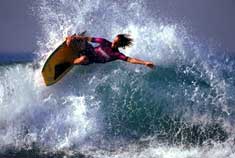
Remember Endless Summer? Bruce's Beauties? Well, that's just one of the
incredible breaks on our coast. The best known surfing spots are around Cape
Town, Durban, Jeffreys Bay and East London, but there are loads of great, virtually
unsurfed waves.
The many backpackers hostels around the country are geared up
for board rental, escorted surfaris and surfing lessons, and there are dedicated surf
schools in Durban and Cape Town.
We have awesome windsurfing and kitesurfing spots. Langebaan, near Cape Town,
is internationally recognised to be one of the top boardsailing venues in the world -
and there are others.
A more accessible way to experience the sea is in a specially designed sea kayak.
There are escorted trips around Cape Town, Hermanus, Knysna, Plett and Durban.
For a bit more of a challenge, try surfskiing - it's becoming a rather trendy pastime
and can be very competitive. Surfskis are really fun boats to paddle - fast,
responsive and with the approximate stability of a razor blade balanced on its edge.
There is a whole series of races throughout the year all along the coast. Check out
www.surfski.co.za.
The South African coastline is one of the most challenging in the world to sail, with
few harbours, stormy conditions and, often, very rough seas. So it's not a good
bareboat option. However, it's a great place to learn to sail - there are sailing
schools in Cape Town, Port Elizabeth and Durban - and we feature on all the major
round-the-world races. There are loads of local races, too, and the Cape to Rio is
one of the most accessible ocean crossing races in the world, attracting a large
cruising contingent.
If you need any convincing about the seriousness of our coast, you need look no
further than the many historical and recent shipwrecks. Of course, these were all
tragedies but still good news for local divers.
We have more to offer than these
poignant sites, though. Our underwater environment is absolutely beautiful and
varied and we have lots of wonderful diving sites.
We have an enormously long coastline ranging from about 35°S to 27°S,
which isn't quite within the usual range of tropical diving. However, the Mozambique
Current which flows down our East Coast brings warm, tropical water with it, and at
Sodwana Bay we have the most southerly coral reefs in the world. Of course, they
have the full complement of pretty colourful fish and some great nudibranchs,
including the outrageous Spanish dancer (Hexabranchus sanguineas). Whale sharks, turtles, dolphins and ragged tooth sharks (Carcharias taurus) are often seen in specific places.
And then, as you head down the coast, the underwater faunal and floral
assemblage changes gradually until, once you've reached Cape Town, you're diving
in chilly but beautiful kelp forests. These, too, are unique. There are three
major
types, or genera, of kelp and it is only off a short portion of the Western Cape
coast that they all grow together.
If you've always shunned cold water diving,
consider it. Sure, you do have to dress up in a great thick wetsuit with constraining
hoodie and gloves but it's worth it. Diving in kelp is like walking in a forest. You float
beneath the canopy and admire the surprisingly colourful reef life. Off Cape Town,
divers regularly see anemones in colours ranging from electric blue or deep red to
pale pink, nudibranchs of almost every colour you can imagine and a whole range of
small creatures in and around the bright orange and sulphur yellow sponges.
There are dive schools in almost every centre, with a surprising number in the
landlocked Johannesburg area. Perhaps it's not so surprising. Most people do their
training up there and then head down to Sodwana Bay for their qualifying dives.
There is even an inland dive resort near
Johannesburg where students can do their
first dive or two in a disused quarry. Badgat is another, much deeper disused quarry
in Mpumalanga where rebreather, mixed gas and deep diving courses are run.
When you come here to dive our wonderful reefs, do take careful note of your
no-fly limits. A flight from sea level to Johannesburg can take only an hour, and you
gain 2 000m (7 000ft) in altitude - that's without even considering the
flight. This really does represent a major risk, so adjust your itinerary to include a
day of sightseeing, shopping or beach lounging between diving and flying or even
driving to Johannesburg.
Source: South African Tourism


|