Home page Tourists page Investors page Citizens page South Africans Abroad page      Südafrika auf einen Blick   L’Afrique du Sud en un coup d’oeil Mon, 30 Oct 2006
Essential Information
  About South Africa
  South Africa map
  SA photo galleries
  SA web directory
  Site map
Public Services
  Advice for citizens
  Advice for foreigners
  South Africans abroad
Doing business
  Economy
  Investing in South Africa
  Trade with South Africa
  Trends & growth
  Business update
Plan a trip
  Holiday experiences
       Adventure
       Culture and heritage
       Exciting cities
       Food and wine
       Sun and surf
     more  Wildlife
  Smart travel tips
What's happening
  South Africa update
  Arts and entertainment
  Conferences and expos
  Sport
Special Features
  2010 Fifa World Cup SA
  SA feature stories
  Gateway to Africa
  Nelson Mandela
  South African women
Weather

South African Weather Service


Quick forecasts
SA Weather Service

South Africa Map
South African Map

Find your way
on our interactive
macro-to-micro South Africa map


FLORA
Two oceans & biodiversity

If you're of a botanical bent, you'll never want to leave South Africa. We have the third-highest level of biodiversity in the world, and ours is the only country to contain an entire floral kingdom.

The Cape Peninsula National Park has more plant species within its 22 000 hectares than the whole British Isles or New Zealand. Some 18 000 species of vascular plant (plants with vessels for bearing sap) occur within South Africa's boundaries, of which 80% occur nowhere else.

Our incredible biodiversity is due to our unique physical features. Most of the country is situated on a high-lying plateau, between two very different oceans.

The Indian Ocean, on the east, is warmed by the Mozambique or Agulhas Current which flows down from the tropics, while the Atlantic, on the west coast, is cooled by the icy Benguela Current which comes up from the Antarctic.

These two different oceans, the prevailing wind and the topography of South Africa combine to create lush forests and subtropical savanna on the east coast, gradually changing to desert or semi-desert on the west coast.
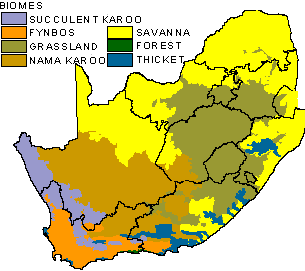

South Africa has seven major terrestrial biomes, or habitat types - broad ecological life zones with distinct environmental conditions and related sets of plant and animal life. (Graphic: Environmental Potential Atlas for South Africa)

Right in the southwest, influenced by swirling cyclonic weather systems travelling up from the low latitudes, the area around Cape Town is totally anomalous.

It has a Mediterranean climate, with hot, windy summers and cool, moist winters, creating a unique floral assemblage, known as fynbos locally, but internationally referred to as the Cape Floral Kingdom.

Although lacking the spectacular array of flowering plants of the fynbos, the rest of the country has much to offer too. Afro-montane forests and grasslands grace the eastern escarpment, and lush coastal forests cloak the rugged Garden Route and Tsitsikamma coasts.

The semi-desert regions have an incredible amount and variety of succulent plants - one-third of the world's succulent plant species occur in South Africa - many of which have a brief but bright flowering season.

And, of course, the lowveld areas are typified by broad-leaved forests which support a rich game population. Not to be missed in the northern part of the country is the fabulous baobab tree.

You can enjoy our botanical riches in the many national parks and botanical reserves or just on the side of the road. The flower season in the Western Cape is in spring - August and September, when specialist flower-viewing trips are run and almost every small town has a flower show.

For a really intimate experience with some big old forest trees, try the tree-top canopy trail in Tsitsikamma - one of only three in the world.

So, when you're next in one of our national parks, remember to take note of the wonderful plants as well as the trees. For more information about our wonderful flora, check out the National Botanical Institute.

Source: South African Tourism

Using SAinfo material Want to use this article in your publication or on your website?
See: Using SAinfo material


Print this page Send this article to a friend


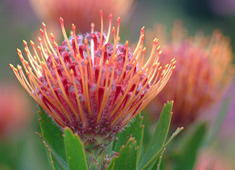
Proteas at Kirstenbosch Botanical Gardens in Cape Town (Photo: South African Tourism)

  • Where the two oceans really meet
  • South Africa's plant life
  • South Africa's geography
  •  Peace Parks Foundation
  •  Greater Limpopo Transfrontier Park
  •  Greater St Lucia Wetland Park
  •  Natal Drakensberg Park
  •  Cape Peninsula National Park
  •  Dept of Environmental Affairs
  •  South African National Parks
  •  National Botanical Institute
  •  South African Tourism
  • Gallery: South Africa's coastline Coastline gallery
    Take a photo tour of SA's varied seashores, from the cold Atlantic of the Northern Cape to the scuba diver's paradise of Sodwana Bay.

    Gallery: South Africa's mountains and rivers Mountains & rivers
    South Africa is big sky country, with vast mountain ranges falling into lush river valleys. Take a photo tour of our more dramatic scenery.

    Gallery: South Africa's National Parks National Parks
    Kgalagadi's desert, Tsitsikamma's forest, Kruger's wildlife ... take a photo tour of South Africa's National Parks.

    Gallery: South African flora South African flora
    South Africa is home to the world's smallest floral kingdom, the fynbos of the Western Cape. Take a photo tour of the country's most beautiful and unusual plants.


    South African Tourism Wines of South Africa Proudly South African South Africa Government Online South African Broadcasting Corporation Department of Trade and Industry South Africa South African Airways JSE Securities Exchange
    Home | Tourists | Investors | Citizens | South Africans Abroad Site Map | South Africa Map | SA Web Directory | SA Photo Galleries
    Design, contents, site maintenance: Big Media Publishers (Pty) Limited
    Queries about the site? Contact the webmaster
    Published for the International Marketing Council of South Africa.
    Reliance on the information this website contains is at your own risk.
    Please read our Terms and Conditions of Use.