South Africa's wildlife wonders
Cities have grown, much land has been given over to farming, hunting has wiped out entire herds, and the times when a herd of springbok could take days to pass through a Karoo town are long past.
Yet, thanks to the foresight of conservationists past and present, South Africa remains blessed with abundant wildlife.
The Big Five
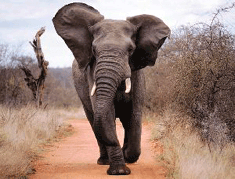
Best known are the mammals, and the best known of these are the famous Big Five: elephant, lion, rhino, leopard and buffalo. Not that giraffe, hippo or whale are small ...
South Africa's bushveld and savannah regions are still home to large numbers of the mammals
universally associated with Africa. The Kruger National Park alone has over 9 000 elephants and 20 000 buffaloes - in 1920 there were an estimated 120 elephants left in the whole of South Africa.
The white rhino has also been brought back from the brink of extinction and now flourishes with a Kruger population of nearly 3 000 and 1 600 in the Hluhluwe Umfolozi Park in KwaZulu-Natal. Attention now is on protecting the black rhino.
Both these parks are home to all five of the big ones, as are other major reserves in South Africa - such as Pilanesberg in North West - and numerous smaller reserves and private game lodges.
The big cats
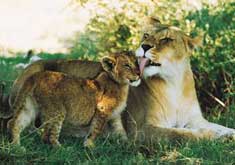
The lion tops the food chain - and the glamour stakes. But it does have one formidable enemy in people, who have expelled it from most of the country so that it now remains almost exclusively in conservation areas.
The beautiful leopard survives in a larger area, including much of
the southern Cape and far north of the country, although numbers are small in some places.
The third of the famous big cats is particularly fascinating. The cheetah is the speed champ, capable of dashes of almost 100 kilometres an hour. However, vulnerable to the loss of cubs to other predators, the cheetah's population is comparatively small and confined mostly to the far north (including the Kruger National Park), the Kgalagadi Transfrontier Park in the Northern Cape, and reserves in KwaZulu-Natal and North West.
Lesser known wildlife
Other quintessentially African large animals are the hippo, giraffe, kudu, wildebeest (the famous gnu) and zebra, all frequently seen in South Africa's conservation areas.
Heightened awareness, however, has created an increased appreciation of lesser known animals. A sighting of the rare tsessebe, a relative of the wildebeest, may cause as much excitement as the sight of a lion
pride stretched out under a bushveld thorn tree. And while one can hardly miss a nearby elephant, spotting the shy little forest-dwelling suni (Livingstone's antelope) takes sharp eyes and is cause for self-congratulation.
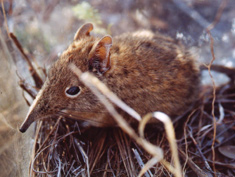
On the really small scale, one could tackle the challenge of ticking off each of South Africa's seven species of elephant shrew - a task that would take one all over the country and, probably, a long time to accomplish.
Over 200 mammal species
With well over 200 species, a short survey of South Africa's indigenous mammals is a contradiction in terms. A few examples will help to indicate the range.
In terms of appeal, primates rate highly. In South Africa they include the nocturnal bushbabies, vervet and samango monkeys, and chacma baboons which - encouraged by irresponsible feeding and under pressure through loss of habitat - have become unpopular as raiders of homes on the Cape Peninsula.
Dassies - hyraxes, residents of rocky habitats - and meerkats - suricates, familiar from their alert upright stance - have tremendous charm, although the dassie can be an agricultural problem.
The secretive nocturnal aardvark (which eats ants and is the only member of the order Tubulidentata) and the aardwolf (which eats termites and is related to the hyaena) are two more appealing creatures, and both are found over virtually the whole of the country.
And for those who like their terrestrial mammals damp, there is the widely distributed Cape clawless otter, which swims in both fresh and sea water. The spotted-necked otter has a more limited territory. Both are rare, however, and difficult to spot.
One mammal whose charm is newly acquired is the wild dog or Cape hunting dog, one of the most endangered mammals in Africa. Once erroneously reviled as indiscriminate killers but now appreciated both for their ecological value and for the remarkably caring
family behaviour in the pack, wild dogs require vast territories. A single pack needs on average several hundred square kilometres.
They are found in small numbers in the Kruger National Park and environs, northern KwaZulu-Natal (including the Hluhluwe-Umfolozi Park), the Kalahari, and the Madikwe reserve in North West province.
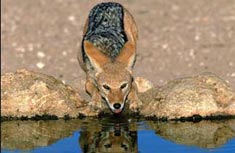
More common canine carnivores are the hyaena, jackal and bat-eared fox. Besides those already mentioned, felines include the caracal with its characteristic tufted ears, the African wild cat and the rare black-footed cat. Other flesh eaters include the civet, genet and several kinds of mongoose.
The plant eaters are particularly well represented by various antelope, from the little duiker to the large kudu and superbly handsome sable antelope, which is found only in the most northerly regions.
Mammals take to the air, too: South Africa is well endowed with bat species.
Marine mammals and
fish
And they take to the sea. The largest mammal of all - in South Africa and the world - is the blue whale, which can grow to 33 metres in length.
But of the eight whale species found in South African waters (including the dramatic black-and-white killer whale), the most frequently seen by humans is the southern right whale. This imposing creature comes into coastal bays to calve, allowing for superb land-based viewing.
The southern right whale represents one of conservation's success stories. Once considered the "right" whale to hunt, its population became so depleted that it was designated a protected species. With the greater familiarity that their return to the coastal bays has produced, they are now as well loved as the many dolphins in our coastal waters.
South Africa's seas are rich in fish species. Perhaps the most awesome of these is the great white shark, but this is only one of more than 2 000 species, comprising 16% of the world's
total. Various line fish, rock lobster and abalone are of particular interest to gourmets, while pelagic fish (sardines and pilchards) and hake have large-scale commercial value.
The crocodile ... and other reptiles
Less generously endowed with freshwater fish - 112 named species, a mere 1.3% of the world total - South Africa nonetheless has one river-dweller that is, as much as any of the Big Five, a symbol of Africa. The crocodile still rules some stretches of river and estuary, lakes and pools, exacting an occasional toll in human life.
Other aquatic reptiles of note are the sea-roaming loggerhead and leatherback turtles, the focus of a major community conservation effort at their nesting grounds on the northern KwaZulu-Natal shoreline.
South Africa's land reptiles include rare tortoises and the fascinating chameleon. There are well over 100 species of snake. While about half of them, including the python,
are non-venomous, others - such as the puffadder, green and black mamba, boomslang and rinkhals - are decidedly so.
The country's comparative dryness accounts for its fairly low amphibian count - 84 species. To make up for that, however, South Africa boasts over 77 000 species of invertebrates.
Birdlife
Birders from around the world come to South Africa to experience the country's great variety of typically African birds, migrants, and endemics (those birds found only in South Africa).
Of the 850 or so species that have been recorded in South Africa, about 725 are resident or annual visitors, and about 50 of these are endemic or near-endemic.
Apart from the resident birds, South Africa hosts a number of intra-African migrants such as cuckoos and kingfishers, as well as birds from the Arctic, Europe, Central Asia, China and Antarctica during the year.
South Africa's birdlife ranges from the ostrich -
farmed in the Oudtshoorn district of the Western Cape, but seen in the wild mostly in the north of the country - through such striking species as the hornbills to the ubiquitous LBJs (Little Brown Jobs).
One small area alone, around the town of Vryheid in northern KwaZulu-Natal, offers wetlands, grasslands, thornveld and both montane and riverine forest, and around 380 species have been recorded there.
A birder need not move out of a typical Gauteng garden to spot grey loeries, mousebirds, hoopoes, hadeda ibises, crested and black-collared barbets, Cape whiteyes, olive thrushes ... or a lone Burchell's coucal poking clumsily around a tree. And that would by no means complete the list.
Among the most spectacular birds of South Africa are the cranes, most easily spotted in wetlands - although the wattled crane is a lucky find as it is extremely uncommon. The beautiful blue crane is South Africa's national bird; the crowned crane is probably the flashiest of the three
with its unmistakable prominent crest.
Among its larger bird species, South Africa also has several eagles and vultures. Among its most colourful are kingfishers, bee-eaters, sunbirds, the exquisite lilacbreasted roller, and the Knysna and purple-crested louries.
Source: South African Tourism


|