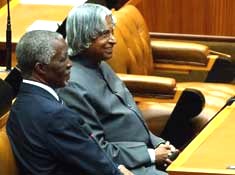
India's president visits SA
16 September 2004
President Thabo Mbeki met Indian President Abdul Kalam at Tuynhuis in Cape Town on Wednesday. Kalam's four-day South African trip marks the first official visit by an Indian head of state since SA gained freedom in 1994.
The two presidents discussed issues of international terrorism, the World Trade Organisation, strengthening institutions of multilateralism, the war in Iraq and developments in the Middle East.
In a statement released after the meeting, Mbeki and Kalam called for the reform of the United Nations "to make it more effective and representative of the contemporary international community".
There should be "an equitable balance in an expanded Security Council to provide a decisive voice to developing countries", they said.
The two leaders noted "with satisfaction the progress achieved at the World Trade Organisation general council meeting in Geneva to remove blockages to the Doha development agenda", commending what
they called an "increased solidarity among developing countries at the WTO".
"India and South Africa share the belief that the emerging world order should be just, equitable, multi-polar and based on the principles of democracy, sovereign equality, territorial integrity, non-interference in the internal affairs of states, peaceful settlement of disputes, and the principles of the United Nations", the statement said.
Call for partnership in education
Addressing a joint sitting of Parliament on Wednesday afternoon, Kalam said South Africa and India should work together in education.
"We need a strategy for promoting the education level of the entire population in a phased manner", Kalam said. The number of young people completing high school had to be increased, he said, while at tertiary level, the number of students finishing their education in professional, science, management, commerce and arts courses should be improved.
Kalam
said South Africa and India could share information on how this could be achieved, adding that the partnership could take the form of teacher exchanges.
Quoting statistics, which indicate that over 50 percent of the population of both countries is below the age of 25, he said this translated into 565 million people in India.
This, he said, was a human capital strength that could be turned into knowledge capital to bring about transformation.
Cape Town, Johannesburg, Durban
After addressing Parliament, Kalam vsited Robben Island for a tour conducted by former prisoner Ahmed Kathrada.
On Thursday, the Indian delegation left for Gauteng to attend the opening of the Pan African Parliament. Kalam was due to meet with former president Nelson Mandela in Johannesburg, and to tour Constitution Hill, which houses South Africa's Constitutional Court.
On Thursday evening he was due to inspect the Mahatma Gandhi memorial plaques in
Durban.
eThekwini (Durban) Deputy Mayor Logie Naidoo said politicians and economic experts in the province were looking forward to Karim's visit, which he described as a significant opportunity for the province.
"We must recall that India was the first country to call for sanctions against apartheid South Africa, and we therefore are honoured to host the president from that country", Naidoo said.
Kalam, accompanied by some Indian Cabinet ministers and business gurus, is expected to meet with KwaZulu-Natal Premier S'bu Ndebele and members of the local chamber of business to discuss strategic trade cooperation issues.
While in KwaZulu-Natal, Kalam will visit some of the historic sites in the province, including the Pietermaritzburg train station, where railway officials enforcing apartheid laws threw Gandhi off a train.
He will also address students at the University of KwaZulu-Natal, and be treated to a civic reception in Chatsworth, South Africa's
largest Indian township, about 10km south of Durban.
Kalam will leave South Africa on Saturday.
Source: BuaNews


|