|
Show your true colours!
2 September 2003
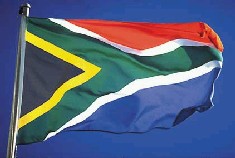
It's a potent symbol of unity and progress. It's the only six-coloured national flag in the world. It's also one of the youngest, yet whatever shape it takes - and it's taken more than any other national symbol - it's instantly recognisable to South Africans everywhere. This Heritage Month, show your true colours - fly your flag!
The new South African national flag first flew on 27 April 1994, "not as a symbol
of a political party, nor of a government, but as a possession of the people - the one thing that is literally and figuratively above all else, our flag".
The quote comes from the introduction to Flying with Pride: The Story of the South African Flag, a coffeetable book derived from the incredible variety of ways in which this unique cloth has become woven into the fabric of South African society.
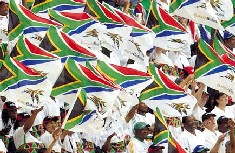
 As in the case of the rocket logo used for the First African in Space project, the South African flag has become integrated into butterflies, bow ties, company logos, trees, top hats, hot-air balloons, umbrellas, underwear … the list goes on and on. As Flying with Pride seeks to demonstrate, the South African flag has no equal in this respect. As in the case of the rocket logo used for the First African in Space project, the South African flag has become integrated into butterflies, bow ties, company logos, trees, top hats, hot-air balloons, umbrellas, underwear … the list goes on and on. As Flying with Pride seeks to demonstrate, the South African flag has no equal in this respect.
Yet the flag was originally commissioned as an interim flag only
- and was very much a last-minute job, barely making it onto the country's flagpoles in time to usher in the new South Africa.
How the flag came to be
How the new flag came to be, and some of the interesting anecdotes that accompanied the transition, form an important part of Flying with Pride, with much of the information provided by Fred Brownell, the former State Herald and the person responsible for designing the flag.
Choosing a new flag was part of the negotiation process set in motion when Nelson Mandela was released from prison in 1990. When a nationwide public competition was held in 1993, the National Symbols Commission received more than 7 000 designs. Six designs were drawn up and presented to the public and the Negotiating Council - but none elecited enthusiastic support.
A number of design studios were contracted to submit further proposals - again without success – and Parliament went into recess at the end of
1993 without a suitable candidate for the new national flag.

The SA flag flies on the highest point on earth for the first time in history: 25 May 1996, Ian Woodall (left) and Cathy O'Dowd. (Picture: Cathy O'Dowd)
In February 1994, Cyril Ramaphosa and Roelf Meyer, chief negotiators of the African National Congress and the National Party government of the day respectively, were tasked with resolving the flag issue. A final design was adopted on 15 March 1994 - derived from a design developed by Brownell.
The proclamation of the new national flag was only published on 20 April 1994 - seven days before the flag was to be inaugurated on the 27th, sparking a frantic last-minute flurry for flag manufacturers.
Writing in the foreword to Flying with Pride, Ramaphosa comments: "It was
difficult to imagine, back then in the days of negotiations, that this assortment of shapes and colours we had before us would become such a central part of defining and identifying a new nation.
"As South Africans daily work to build a better society, they are surrounded in many forms and countless manifestations by a flag which recognises and celebrates the unity and diversity of the country's people.
"Few would have imagined, almost a decade ago, that this collection of colourful shapes could become such a potent symbol of unity and progress. But then fewer still would have thought that a country torn apart by decades of racial oppression could transform itself into a beacon of democracy and hope."
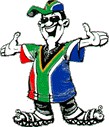 Flying with Pride is available at bookstores and hotels, or can be ordered by calling (012) 991 3083 or
visiting the Flying with Pride website. Flying with Pride is available at bookstores and hotels, or can be ordered by calling (012) 991 3083 or
visiting the Flying with Pride website.
SouthAfrica.info reporter
| |
 |
 |
|
"I never expected to do something under the colours of my country, to make any kind of public contribution to the achievements of the nation. But now as I looked down at what was for a brief moment the highest flag in the world, I was proud to be South African, and proud to have forged a small place in the history of my country."(Cathy O'Dowd, member of the first South African Everest expedition and the first woman in the world to climb both sides of Mount Everest)
|
|
|
|
 TIPS ON FLYING YOUR FLAG
When displayed horizontally, the black triangle should be to your left and the red band uppermost. If the red band is at the bottom, you're flying your flag upside down - the traditional sign of surrender (or if you're at sea, the international maritime signal of distress)!

When draped vertically, a flag should not merely be rotated
through 90 degrees, but also reversed. In the case of the South African flag, the black triangle must be uppermost and the red band to your left. (One "reads" a flag like the pages of a book - from top to bottom and from left to right - and after rotation the results should be the same.)
The flag may not be defaced by placing slogans or any writing or design directly on the field of the flag. Any writing should appear next to or underneath the image of the flag.
The flag must always be treated with dignity and respect. According to the Regulations Regarding the Flying of the National Flag, the flag must never:
- Be allowed to touch the ground or floor.
- Be draped over tables, lecterns, podiums, platforms or railings.
- Be used to cover a statue, monument, plaque, etc at unveiling or similar ceremonies.
- Be manufactured or used as underclothes, bath mats or any similar demeaning application.
- Be used for any commercial advertising in a
manner that distorts or shows disrespect to the flag.
The flag should be hoisted at the start of the working day and lowered again at or before sunset. It should not remain flying at night unless suitably illuminated. The flag should be hoisted briskly and lowered ceremoniously.
Use of the flag in artefacts and products is subject to the approval of the Presidency and, in the case of manufactured items, the Department of Trade and Industry.
For full information on how to handle and display the flag correctly - and on how to draw and colour your own flag - check out our SA Flag Guide.
|
|
|